
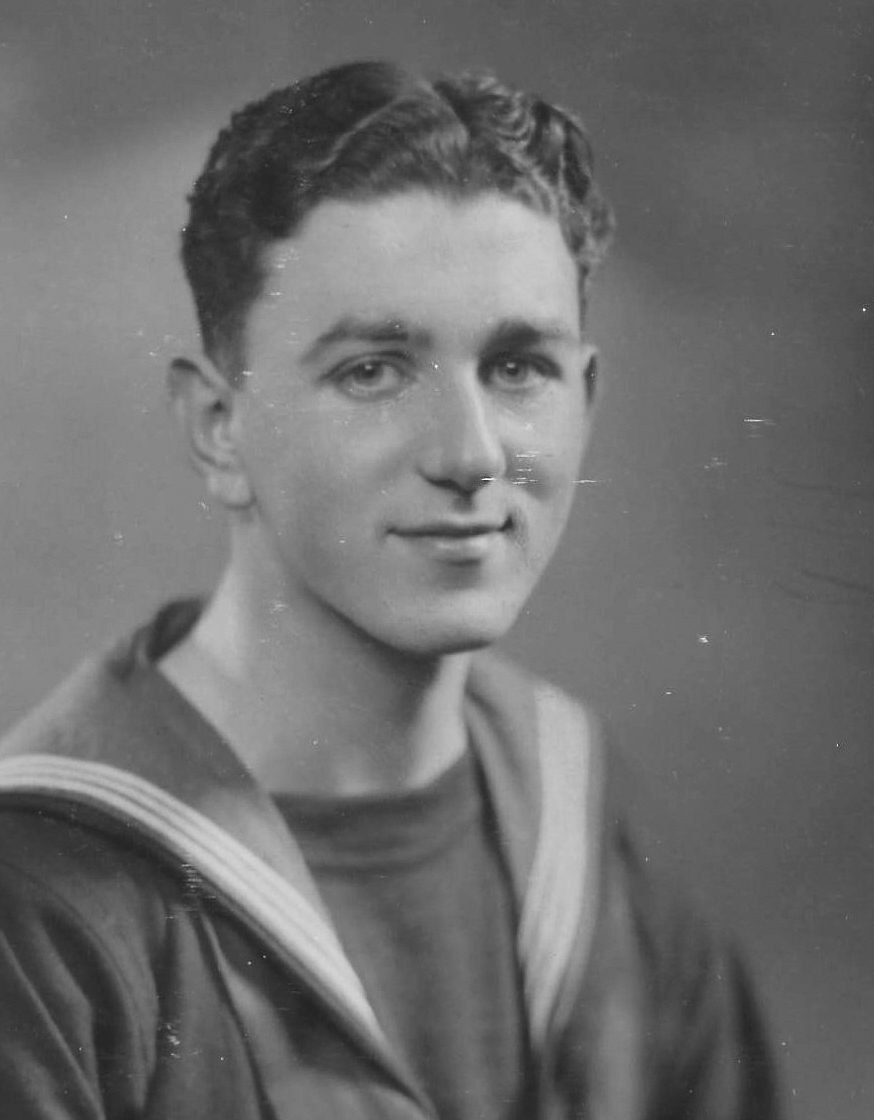
A man who served in Winston Churchill’s Battle of the Atlantic, later helped launch Alsager’s teacher-training college, and had a building named in his honour at Alsager’s sports hub, has died aged 104.
Jim Collorick started work at the new teacher training college in Alsager, which later became the MMU Campus. He was the college bursar from 1946 until he retired in 1982.
In October 2020, Mr Collorick officially opened the building named in his honour.
He died peacefully on Thursday, 19th March, leaving his son David and daughter-in-law Jane. He married his childhood sweetheart Joyce and they were together for almost 68 years.
Mr Collorick was just 20 when he served on board Royal Navy destroyer HMS “Hesperus” as a Morse code reader. It was on convoy escort duties in 1942, helping to ensure vital supplies and troops made it across the sea.
On Boxing Day that year, six German soldiers were spotted in the sea after the “Hesperus” had “death charged” their U-boat, slicing it in half.
Naval officer Mr Collorick, originally from Holmes Chapel, was positioned in the wireless room on HMS “Hesperus” when he heard the signal “Standby to ram!”
Convoy commodores had tried all day in daylight to catch the enemy submarine and at 8pm that night the signal naval officers had practised many times became a reality.
The destroyer’s engine was revved up, “screaming with the pressure,” and then “Crash!” said Mr Collorick.
He recollected being knocked out of his chair. “But that was nothing,” he said.
“For seconds, we didn’t know if he’d torpedoed us or whether we’d got him! Then we heard the lads on the bridge cheering, so we knew we had him, and down he went with 60 to 80 men.”
With the magnitude of the collision, all the radio signals disappeared, and despite his best attempts to retrieve them, he said all the aerials had been damaged and he instantly became a “spare hand”.
Instructed to grab his raincoat by the wireless cabin chief, Mr Collorick was ordered up onto the forward deck of the ship, the fo’c’sle (forecastle), to retrieve the few outstanding German survivors.
The six men were hauled up on scramble nets. One died immediately.
“We didn’t chuck him back. The law of the sea commanded you look after the dead as well as the living,” recalled Mr Collorick.
Four of the five survivors were Hitler youth from the youth wing of the German Nazi Party, and the fifth was an elderly man whom Mr Collorick discovered was an English teacher and a “lovely fellow”.
“I latched onto him, immediately,” he said.
“There was one stage when the others weren’t looking, he put his hand out to me, and he gripped it, and he said ‘Jim’ – because I encouraged him to be friendly – ‘Jim, what is it all about?’ and shook his head. It was so sad.”
He was on duty in Egypt as Britain celebrated victory on VE-Day.
He recalled: “I was on duty watch in Alexandria naval base. All the chaps on the other watch were in Alexandria having a wonderful time, so VE-Day itself for me was a great disappointment.”
After VE-Day he was “on draft” for the Pacific fleet but was never posted as the Japanese surrendered after two atom bombs were dropped on Hiroshima and then Nagasaki, bringing an end to World War Two.
Recalling how he felt after the war he said: “We wanted to get back to our civilian lives – we wanted to get on with our careers. I was 23 when the war was over and was still a youngster.”
On his return to civilian life Mr Collorick helped to build a new teacher-training college in Alsager, which became the largest in England.
He was a founder member of the college in 1947. It was set up as an emergency college because of the demand for teachers after the war, and was due to have closed after two years.
During the Second World War a hostel built of wooden army huts was constructed to house workers at the Royal Ordnance Factory, Radway Green, and was called “Heathside”. In 1945 it became “Alsager Training College” for the training of teachers, who were in short supply.
Due to the college’s success it became a permanent college in 1949 and he was its bursar until he retired in 1982.
The wooden huts were still in use for housing of students until the early 1960s. MMU absorbed what became Crewe and Alsager College of Higher Education, forming the Crewe and Alsager Faculty, subsequently renamed MMU Cheshire.
When we interviewed him in 2020 for the 75th anniversary of VE-Day, he was still sprightly, and said: “I do my own shopping, my own cooking and the ironing. I just keep going and don’t give up.”
The Collorick Pavillion, off Dunnocksfold Road, forms part of the sports hub, which includes hockey and football pitches.
He celebrated his 100th birthday with friends and family at his retirement home at Lovell Court, Holmes Chapel. He and his wife retired to Chester until 2007, before moving to Holmes Chapel.
His family will be having a private funeral service in his memory.