

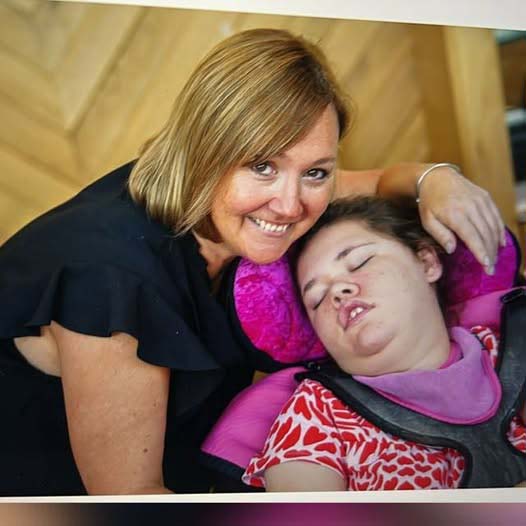
The mum who set up Congleton charity Ruby’s Fund hopes a “test case” court judgment, which granted her power to make decisions on her daughter’s behalf in adulthood, will help other parents in a similar situation.
The Court of Protection concluded that Alison Parr was “uniquely placed” to decide what care most suited 18-year-old Ruby, who was born with a chromosome disorder and has severe learning difficulties.
Her case was against Cheshire East Council and Cheshire and Merseyside Integrated Care Board.
Ms Parr’s previous application to be Ruby’s personal welfare deputy when Ruby was still 17 had been refused, the judgment having been based on documents only, without a court hearing.
As a result, the application has since been reconsidered and in his judgment earlier this month not only did Mr Justice Poole say Ms Parr had “doggedly fought her daughter’s corner” but that she had “built up such expert knowledge of her daughter’s health and care needs that she often leads professionals to arrive at solutions and to make decisions about how to look after Ruby” and that Ms Parr’s “energy and commitment appear to have no bounds”.
Ms Parr, (50), said successful applications for personal welfare deputy were “rare and really hard to get” and were more common in relation to being able to make financial decisions on someone’s behalf.
She told the “Chronicle”, “Without it, my fear was that when Ruby was an adult, my voice would not be heard, because in the eyes of the law, statutory support is adequate to look after our young people as adults. But my evidence proved that wasn’t the case.”
Ms Parr had told Mr Justice Poole that over the years she had noticed “increasing inconsistency and gaps” in the resources available to support Ruby, and in communications among professionals and between professionals and the family.
Mr Justice Poole said: “She told me about the lack of continuity in care and support. This has led to frustration, anxiety and obstacles to securing Ruby’s best interests which Ms Parr believes would be overcome were she to be appointed as Ruby’s personal welfare deputy.”
Ruby suffers from 30 seizures a day, is fed via a tube into her stomach, and a chronic lung disease means she needs oxygen therapy at night.
Cuddled
The judge had been told that she enjoyed being cuddled, having baths, being taken outdoors in the fresh air, travelling in her vehicle when she particularly enjoyed the sensory experience of travelling over uneven road surfaces, and using her sensory room at home.
Mr Justice Poole said: “I have no hesitation in finding that Ruby lacks capacity to make decisions for herself about her personal welfare and health, including treatment decisions.”
The papers also outlined Ms Parr’s professional background. They said she was a former qualified NHS nurse but stopped work in 2010 to become Ruby’s full-time carer. Paid carers also visited Ruby at home but Ms Parr was the lead carer.
The judgment papers said it had been difficult to secure funding and appropriately trained carers due to the complexity of Ruby’s needs.
The judge gave several examples of the obstacles her mum had faced over the years, including when a demand for proof of entitlement to exemption from prescription charges was sent to Ruby. Ms Parr’s word as to Ruby’s inability to respond was not initially accepted and Ruby was threatened with a fine.
She has had eight different social workers in the last three years and three different dietitians in the last six months, and there was a high turnover of staff within the various public services that supported her, the judgment said.
New personnel have to learn all about Ruby’s complex needs from reading “voluminous documentation”.
The judge said: “There is much for them to learn and Ms Parr fears mistakes being made if she is not contacted when decisions have to be taken about Ruby’s health and welfare.”
Information was also given about an emergency when Ms Parr felt “helpless” as paramedics, “unaware and unpersuaded” that Ruby’s epilepsy could cause a form of “stasis”, sought to commence CPR thinking that she was in respiratory arrest, which put Ruby at risk.
The judge said in his findings: “Now that Ruby is an adult, Ms Parr does not have a status as someone with parental responsibility, with which to impress her views on Ruby’s best interests in emergency situations. These situations arise all too frequently for Ruby and deputyship would give Ms Parr status and a voice which Ruby badly needs when emergencies arise.”
The judgment said Ms Parr had also had to address “glaring inconsistencies” in Ruby’s education health and care plan, which included contradictory statements such as that Ruby was PEG-fed and nil by mouth, and that she ate food orally.
The judge said Ms Parr told him she typically got four hours of broken sleep a night due to Ruby’s needs.
Mr Justice Poole said: “Having listened to Ms Parr, I have no doubt that she is highly attuned to her daughter’s needs, always acts in what she considers to be Ruby’s best interests, and is extremely well placed to assess what those best interests are, including in medical emergencies and when making decisions about her residence and care.”
The judge said it was likely that a decision would be made early next year about whether Ruby should move out of the family home and into a unit run by a specialist care provider. “If she does move, decisions will have to be made about the care provision there and her mother’s involvement,” he said.
The judge added: “I cannot ascertain Ruby’s wishes and feelings about the application, but I am sure she unconditionally trusts her mother. The views of her close family members and those who care for her professionally (at least those about whose views I have evidence) unanimously support the application and view the proposed appointment as being in Ruby’s best interests.”
He also referred to Ruby’s Fund, the award-winning charity set up by Ms Parr, based on Roe Street in Congleton, which supports the borough’s children and young people with special educational needs and disabilities and their families and carers.
Ruby attended the court hearing with her mum and other members of the Parr family.
Delight
In his concluding remarks, Mr Justice Poole said: “It was a delight to have Ruby in my courtroom and inspiring to learn of her life and the devotion to her of her family, in particular of Ms Parr. Her energy and commitment to fight Ruby’s corner, time and time again, is truly impressive. She has sacrificed a great deal in her drive to do what is best for her daughter. She has also helped many others through Ruby’s Fund.”
He added: “Ruby is fortunate to have been born into this family and to have so much love, care and support given to her. I wish her and the family the best for the future.”
Following the decision, Ms Parr said on her LinkedIn page: “I remain focused on what this process should always be about: ensuring that disabled people are supported with dignity, care and respect, and that the voices of those who know them best are genuinely heard. As Ruby’s mum, the judge’s words in the concluding remarks have – and will – always bring me to tears. I knew (Ruby) turning 18 would be hard, but I underestimated just how hard this last 18 months would be. For now, I will pause, recuperate and cuddle my girl with the reassurance I have been heard, that I am not a difficult parent, that I simply love my girl and will always do my best for her.”
Ms Parr said she was “grateful” to the professionals involved in Ruby’s care who “engaged thoughtfully” and “to those who supported me through a long process that has been emotionally and practically exhausting”.
She also praised award-winning Congleton disability advocate Dr Deborah Lawson, whose support she said had been “amazing” because of her “fount of knowledge”, having helped, in her professional capacity, to prepare Ms Parr’s court bundle.
Ms Parr told the “Chronicle”: “This has been an 18-month journey knowing that transition into adulthood is really difficult, you can’t prepare for that and for how difficult it is.
“There were lots of different professionals who were in and out of our lives for the duration of Ruby’s childhood and that was their job. But as her mum I am the consistent person who knows her best.
“Ruby has had social workers for a number of years; how can they make a safe decision? They can’t know somebody just by reading a report. They are just words on paper. Ruby’s a human being with a life.”
Her message to parents in a similar situation was: “Read the court judgment and see if it resonates with you.”
She said she had been on an “emotional rollercoaster” when preparing for the court hearing, had struggled with the financial cost and ended up representing herself. “I had never been to court and had stood before a judge. So you need to be resilient and determined.”
Ms Parr added: “What I hope is the judgment will be able to be referenced with supporting evidence that other people may bring in similar situations.”
She wasn’t the only one who referred to the judgment as a “test case”.
Having read it himself, independent social worker Gary Spencer-Humphrey, a founding director of Hampshire-based Nova Care Consultants, posted on LinkedIn that it was a “landmark case” in his view “because it invites social work leaders and managers to reflect on their practice and adapt to an evolving legal landscape.” He added: “As the number of adults with lifelong complex needs rises and courts show a willingness to empower family deputies, these lessons will become increasingly relevant. By investing in continuity, valuing family expertise, respecting legal authority, and advocating for the best interests of vulnerable adults, social workers can ensure they remain at the forefront of safeguarding vulnerable adults.”
Cheshire East Council and Cheshire and Merseyside Integrated Care Board were asked to comment.
(Photo: Ruby’s Fund)