
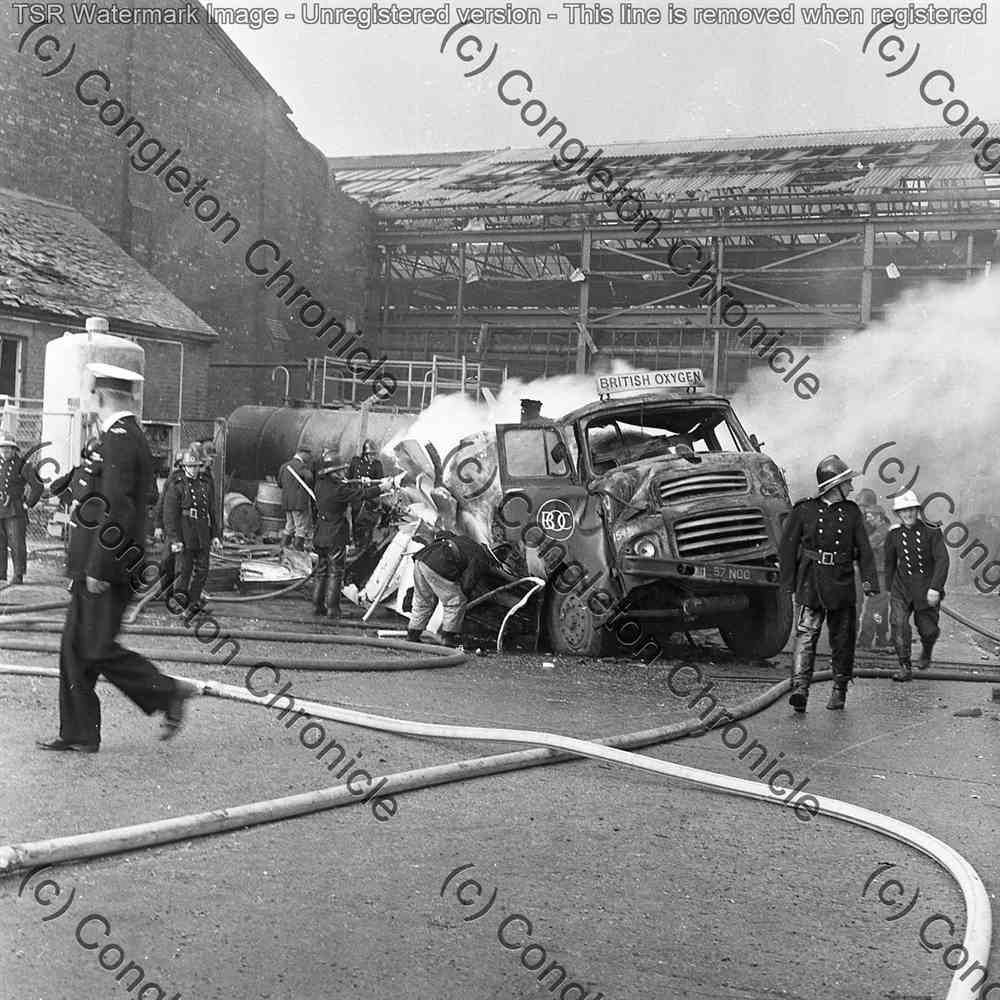
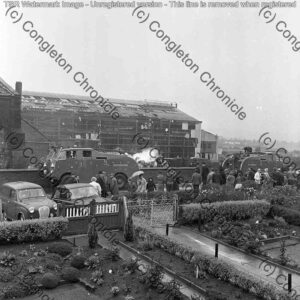
The horror of Biddulph’s biggest post-war disaster at the engineering firm of Cowlishaw Walker hit the town with the same impact as the explosion that reduced a workshop to a skeleton of twisted framework and nearby houses to battered shells.
Two men died within seconds of the blast, which left their six-ton tanker containing liquid oxygen an almost unrecognisable mass of flaming metal. Others crawled bewildered and bloodstained to safety after being showered with flying glass and debris.
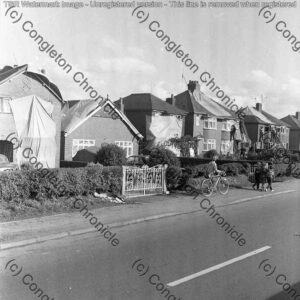
All this happened in minutes as the prologue to a scene of devastation reminiscent of wartime bomb-shattered towns. It turned a main road into a casualty ward as rescue workers weaved their way in torrential rain between fire engines, ambulances and yards and yards of snaking hoses.
Within 15 minutes of the fatal blast, firemen rubbed shoulders with policemen; rescue teams — one from nearby Victoria Colliery — joined staff from the firm, and neighbours and relatives rushed to the scene to help householders clear the mess inside their damaged homes and fight with plastic sheeting and tarpaulins to keep out the pouring rain.
Though the road was closed to traffic, crowds lined the pavements as the dead and injured were carried away.
Most of them marvelled at the miracle that only the unfortunate driver of the tanker and his mate had been killed and 11 people injured.
Since Friday, various aspects of the disaster have combined to form a story of heroism, tragedy and a generous helping of luck.
Heroism — from the band of workers who fought the fierce blaze with fire extinguishers before it could engulf other tanks of inflammable liquid near the wrecked tanker.
Tragedy — for the men who lost their lives and in a smaller way for the injured and for those whose homes were torn apart and whose valuables were damaged in a split second of fire and thunder.
Luck — for the passengers of a double-deck bus that is believed to have passed the scene seconds before the blast, and for many others who might have been tragically hit if …
IF
That little word “if” plays a big part in the story that surrounds the disaster. IF Mrs Sylvia Jones, of Walfield Avenue, Congleton, had not been late in arriving at her mother’s home right opposite the disaster scene, her baby would have been asleep in the front room which was littered with broken glass.
IF the explosion had occurred a short time earlier, six men would have been in the wooden hut that was completely destroyed.
IF she had not been called back to check something in the office, Mrs Brenda Ratcliffe, of Mill Hayes Garage, would have been driving past at the moment of impact.
Countless stories of near-tragedy have been heard, but probably the luckiest men of all were those working nearby and in the shattered machine shop.
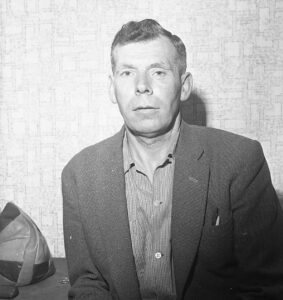
Men like Mr Harold Desmond, of 70, Railway Cottages, Brown Lees, who is one of the luckiest men alive today. He was only eight yards away from the explosion when it happened!
“It’s a miracle I’m alive today,” says the 50-year-old ex-Grenadier Guardsman.
“The blast must have gone straight over my head without touching me.” But let Mr Desmond tell his own story.
“I was going outside and some instinct made me look up and I became conscious of the vehicle. I thought I recognised the driver but as I went nearer he turned sideways and I saw it was not the man I thought it was.
“The vehicle was already piped up and the driver turned the valve.
“Suddenly he turned away to shield himself and tried to run. I tried to run sideways still looking at the lorry. The man had only got two yards away when the vehicle exploded.
“A ball of flame enveloped the lorry and the man and blotted them from my vision.
“It was like a 1,000lb bomb exploding. I felt the force of the explosion but it never hit me; it must have gone straight over the top of my head.”
Mr Desmond then ran into one of the workshops to warn the men and afterwards went back to the fire but could not get anywhere near the lorry.
“I am the luckiest man on the firm,” he admits.
“For ten minutes I was all right because I did not realise what had happened. Then the realisation of the tragedy hit me, and I started trembling and felt sick.”
Mr Desmond is still on the sick list this week suffering from terrific headaches due to the blast, and shock.
It was his second lucky escape — during the war, a bomb exploded half-a-yard away from him as he was lying on his face but never injured him!
Almost as lucky was Mr Derek Newton, a plater, of 240, Park Lane, Biddulph.
He was probably as near as anyone to the blazing inferno.
“I was in the washroom of the boiler shed when I heard the bang. I can’t remember being knocked down — just a terrific explosion followed by flying debris and glass.
“The lights went out and the door I had just come through was on its side,” he declared.
Mr Newton had injuries to his leg, arm and head. “If the end of the building had been corrugated like the machine shop, I would not be here today,” he says.
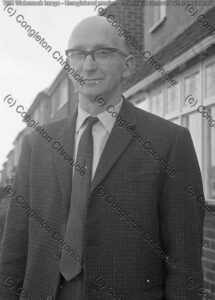
Mr Alec Copestake (51), of 72, Brown Lees Road, Brown Lees, was not injured but suffered a slight heart attack. He had a heart operation in 1960 and his heart was not as normal as it should be.
“It was delayed shock that caused it. There was a terrific explosion and the sides of the building came in. The roof lifted and then came down showering us all with glass and debris,” he explained.
“Twenty minutes later the shock took effect. My legs just seemed to fold under me and the next thing I knew was being carried to the ambulance room by a mate,” he added.
Another lucky man is Mr Trevor Robert Bloor (19), of 8, Greenway Road, Biddulph, who had 30 stitches in the top of his head and four on his face as a result of falling glass.
“After the explosion, it seemed as though we were in a hailstorm of glass. I was terrified — it seemed as though the whole place was going to give in,” he said.
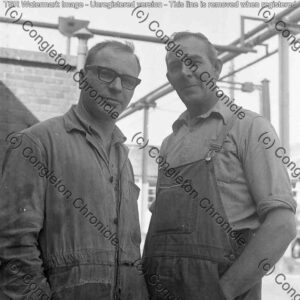
Mr Albert Roden, of 28, Moorland Road, was in the machine shop. “After the bang, things were flying everywhere and broken glass came tumbling down from the roof. I got a cut just under the eye — if it had been half an inch higher it would have blinded me,” he said.
Also injured was Mr Harold Shingler, of 144, Caulton Avenue, Chell.
“I got cut on the head with flying glass. I can’t remember being knocked over but the whole place shook,” he says.
Among the heroes of the disaster were maintenance men Mr Alan Whitehurst, of 7, Highfield Road East, and Mr Tony Walley, of 14, Wells Street, who were 50 yards away when the tanker went up.
“We rushed down to the tanker, looked in the cab and could not see anyone. We then dashed to the shed, knocked down the door and checked that no-one was inside. We saw a man badly burned lying on the line but there was not much we could do for him so we fetched the nurse.”
Alan and Tony then went to fight the blaze round the tanker.
“We were handed fire extinguishers and managed to put out the fire, which was threatening nearby tanks. If they had gone up, it would have blown all Biddulph up,” Alan said.
Meanwhile in the houses opposite, Mrs Lydia Blunt was reading the paper in the back room of her home.
“I heard the explosion and a pile of soot came tumbling down. I went into the front room and there was glass everywhere all over the furniture and the carpets and when I went upstairs I found the ceiling in the back bedroom had dropped on the bed,” she said.
After recovering from the shock, Mrs Blunt helped relatives and friends to start clearing up the mess.
Two doors away Mr Joseph William Lancaster was sitting in the front room with his wife and two daughters.
“I’ve never heard anything like the explosion in my life before. We were all covered with broken glass and had small cuts but we were lucky it was not worse,” he said.
Mr Lancaster’s home was not so lucky — the wall separating the two main bedrooms was buckled and has had to be rebuilt, the ceilings caved in and light could be seen through the roof.
“We’ve had to move out to live with relatives in Biddulph. It may be a month before it’s repaired,” he said.
Mrs Bessie Doorbar, who lives at 223, was working at a nearby garage.
“I heard the explosion but I never thought it was as bad as it turned out. I was taken home and was shocked when I saw my bungalow with all the windows shattered and the roof damaged,” she said.
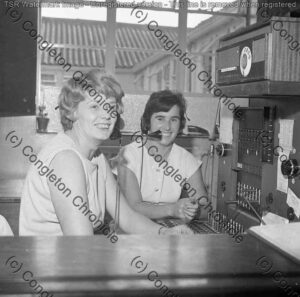
In Cowlishaw Walker’s administrative block, telephonists Mrs Shirley Williams of Foster Avenue, Congleton, and Mrs Iris Botham, Mill Hayes Road, Knypersley, made the most important call of their lives — a 999 call to the police — within seconds of the blast.
“We didn’t really know what it was at the time, but we knew it must be serious,” said Jean.
Nurse Rose Hall of Chell was one of the first on the scene helping the injured.
Another member of the staff quickly on the scene was personnel officer Coun Leslie Frost. After making sure no-one was in the affected area he organised a roll call and arranged for cups of tea for the injured and helpers.
“It could have been much worse. There were more than 100 men working in that area but luckily only 11 were injured,” he says.
Mr Frost said it is understood that part of the lorry was thrown on to the top of the 70ft-high machine shop and crashed down through the roof.
Added Mr Frost: “We were extremely lucky. This is the worst accident at the mill in my experience and I have been here for 25 years. All the employees reacted extremely well; there was no panic and everyone played a vital part, especially Nurse Hall, who gave a tremendous amount of assistance to the injured.”
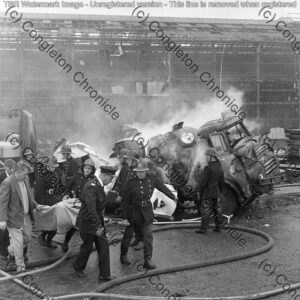
Rescuers
A team of rescue workers from Victoria Colliery, including Biddulph Council’s former chairman (Coun Len Jackson), were on the scene within minutes.
All weekend, the firm’s employees were busy repairing the devastated area. And this week production was back to normal except in the worst-hit area.
Residents nearby were full of praise for the workmen who spent the weekend repairing their damaged homes. Most of them had broken glass replaced and roof tops temporarily repaired by Saturday.
Inquest
Five days after the tragedy, an inquest on the two dead men was opened at Biddulph police station on Wednesday when evidence of identification was given.
Mr Eric Leslie Wight, a transport superintendent of Daveyhulme, Manchester, said he identified the body of the driver, Mr Alfred Clare of 346, Worsley Road, Swinton.
He told the inquest that he had known Mr Clare for 13 years; he had worked under him. Mr Clare had been a driver with British Oxygen since 1953 and had driven liquid oxygen since 1956.
Mr Vincent Kevill, Charles Street, Swinton, gave evidence of identifying the body of his brother, Mr James Kevill (40), of 8, Hazelhurst Fold, Worsley.
The North Staffs Coroner (Mr John Marshall) adjourned the inquest until 28th September to enable technical tests to be carried out to establish the cause of the accident.
Mr Clare was married with a 17-month-old daughter. Mr Kevill was married with a six-year-old son.
Injured
The eleven injured in the disaster were: Mr R Clowes, Manor House Farm, Bagnall; Mr D Newton, 240, Park Lane, Biddulph; Mr A Roden, 28, Moorland Road, Biddulph; Mr A Copestake, 72, Brown Lees Road, Brown Lees; Mr S D Roberts, 52, Hugh Bourne Street, Brindley Ford; Mr J.E. Harding, 5, Congleton Road, Mow Cop; Mr J Lawton, 19, Chapel Lane, Harriseahead; Mr T Bloor, 8, Greenway Road, Biddulph; Mr J Painter, 70, Fegg Hayes Road, Fegg Hayes; Mr H Mountford, 32, Warwick Street, Biddulph; Mr H Shingler, 144, Caulton Avenue, Little Chell.
In charge
In charge of operations was Inspector WM Cole of Biddulph, who had 20 policemen on the scene and directing traffic in neighbouring areas.
Helping to control the fire and in rescue operations were firemen and vehicles from Biddulph, Congleton, Newcastle, Stoke, Kidsgrove and Burslem. In charge was Divisional Officer J. Cowan and Assistant Divisional Officer E Goode of Newcastle.
Three ambulances, two from Biddulph and one from Newcastle, dealt with the dead and injured.
This week the board of directors and management of Cowlishaw and Walker had nothing but praise for the efforts everyone had made and the help they had been offered.
Said deputy managing director Mr NH Pout: “We would like to express our deep gratitude to everyone who co-operated and helped in minimising the effects of the disaster.”