
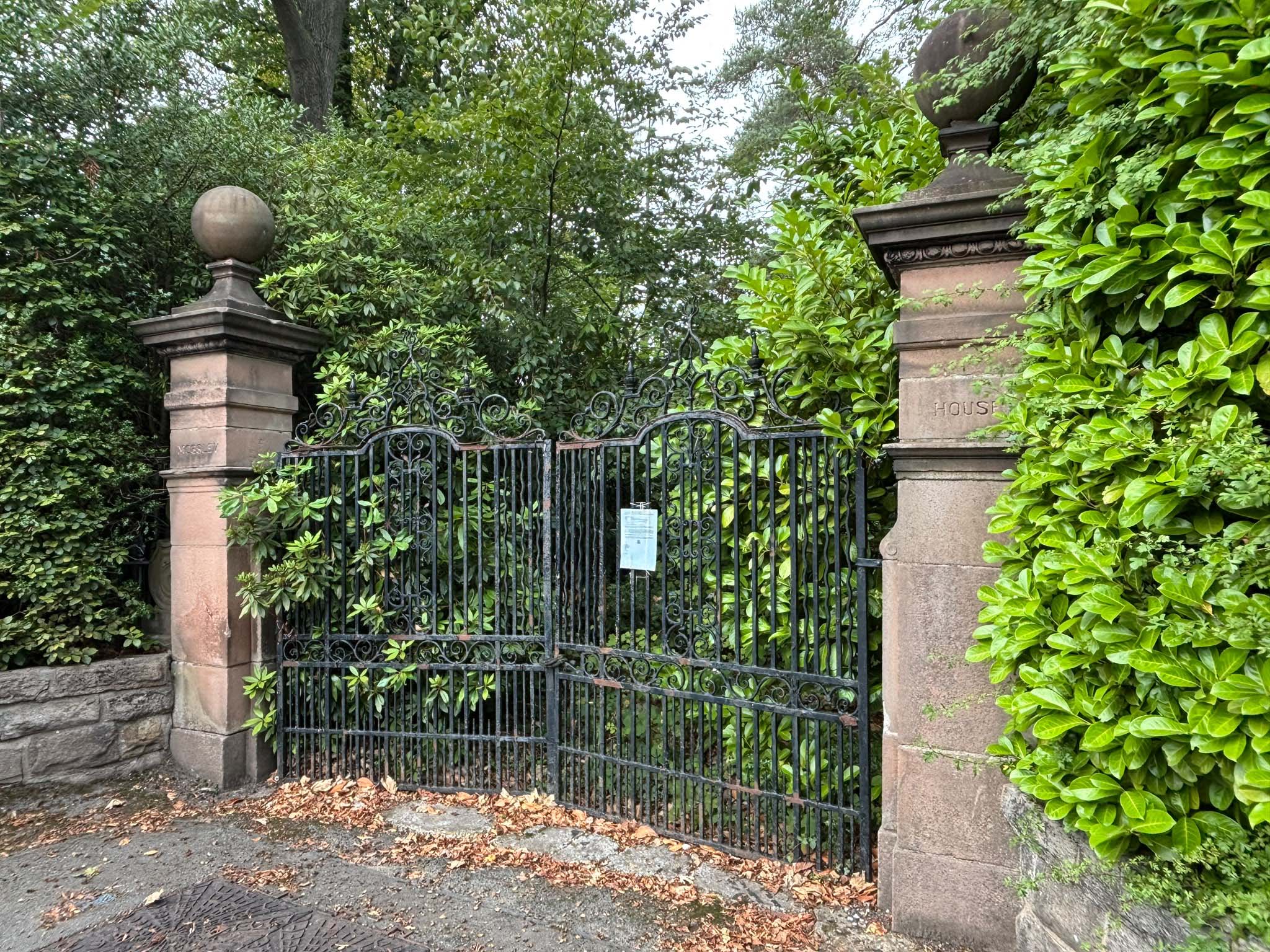
“Historically valuable” gates in Mossley could be saved after the owners have agreed to donate them to the town council.
Cheshire East has approved the removal of the gates to Mossley House, opposite Holy Trinity Church, and their replacement by a low-level wall, despite Congleton Town Council’s objection and Cheshire East’s own initial objections.
Chief officer of the town council David McGifford, Coun Robert Douglas and Coun Kay Wesley recently met managing agent Sycamore Gardens, which acts on behalf of the ten residents of Quarry Close, who collectively own the gates.
Coun Douglas said the managing agent said they would be willing to donate the gates to the town council on the understanding that they would be refurbished, so they could remain in their position, between the gate pillars.
Coun Douglas said: “The managing agent thought that this was a good suggestion and agreed to put it to the residents of Quarry Close.
“Our officers will now be obtaining costings to refurbish the gates. While this will result in further costs for the residents – to amend the planning application – if this route is acceptable, the applicant would be saved the cost of building the wall.”
If the route is adopted, Coun Douglas said the council would require an agreement from the residents to preserve the gates in situ, as they would become a Congleton Town Council asset.
As we reported last month, a concerned resident, who wished to remain anonymous, wrote to Coun Wesley, who chairs the town council Community Committee, to explain the history of the gates, which date back more than 150 years.
They said that in 1913, Mr Clyde Chappell had operated his solicitor’s office from Mossley House. This has now been demolished, leaving only the gates.
They said that the gates had been taken during WW2, as there was a demand for iron to build armaments – though most was used in the post-war reconstruction, when demand vastly outstripped supply.
After getting them back, Mr Chappell found the gates had been badly damaged.
He took them to the concerned residents’ grandfather’s smithy on Blacky Bank (Reades Lane) for repairs. After the extensive repairs, the gates were rehung by Harold and Reginald Cottrell.
The resident added the gates needed to be restored but were made from wrought iron, meaning they could last for centuries if looked after.