

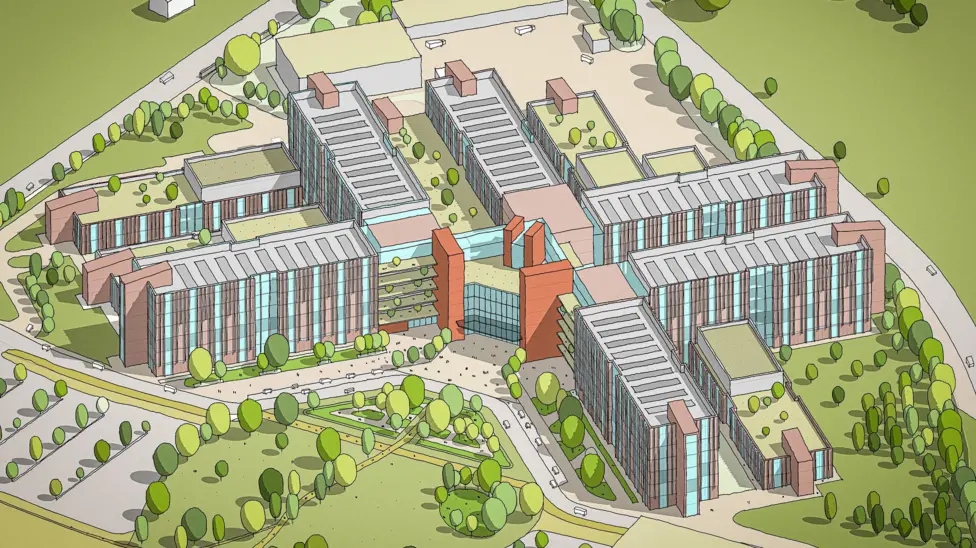
Mid Cheshire Hospitals NHS Foundation Trust has launched a seven-year digital and data strategic plan to 2033 as work gets underway on building a replacement hospital.
The plan will focus on four domains for the deployment of AI, covering clinical, operational, workforce and patients, with each domain represented across five stages through the strategy.
The move is part of the plan for the new Leighton to be an “intelligent hospital”, one that brings together people, processes, technology and data to create a “connected, adaptive environment where digital solutions enhance every aspect of care”.
The trust said the intelligent hospital was not just about new buildings or IT systems, but about “reimagining how patients, staff, and partners interact with services, ensuring that care is safer, more efficient, and truly patient centred”.
On the initial stage of AI deployment, AI will be used to support staff by processing and presenting information, with summarisation, documentation, and ambient voice technology for clinicians, reporting and basic analytics for management, workforce functionality and admin support for HR and improved delivery and navigation for patients.
Decisions will be made by humans at this stage, the trust said, with governance centring on transparency, privacy and mandatory human review.
The trust said: “Sometimes AI will just help us, at other times it will run more independently but with humans checking the results.
“We will ensure this is safe and effective by following strict rules about how and what we buy and working with staff and patients to introduce AI successfully.” The second stage, named the “recommend” stage, sees the use of AI to provide insights and recommendations in clinical decision support, diagnostics, operational flow prediction and discharge suggestions, workforce productivity insights and task prioritisation, as well as patient triage prompts and personalised pathways.
This will be on a “human-in-the-loop basis”, with clinical safety assurance, validation, and audit being key parts of governance, according to Mid Cheshire Hospitals.
The theme of human approval is also found in stage three, termed “enable”, in which AI can prepare or initiate actions, but still requires human approval.
This may be areas such as pre-populating clinical notes, orders or care plans, workflow automation or automated patient communication, the trust notes.
Increased clinical safety officer oversight, audits, workflow controls, role-based accountability and bias monitoring, will all be included in governance.
Stage four is named “automate”. AI will be able to execute defined actions within safe boundaries, dependent on quality data.
This will be for “limited and tightly controlled” clinical use cases, with automation of low-risk processes for the workforce, service automation of appointment management for patients and operational uses such as scheduling and logistics.
Decisions will be subject to human monitoring and overrides, with the existence of set thresholds and fail-safes to promote safe use.
On the final stage, “decide and act”, AI will be “autonomous”, making and executing decisions independently in the future state, the trust said.
In clinical use, this will mean advanced diagnostics and robotics; in operational, it will be used in autonomous system optimisation; and for the workforce, it will see fully automated processes.
For patients, it will mean “adaptive, continuous care pathways”.
The details of the AI plans were given in the Board of Directors meeting on 30th July.