

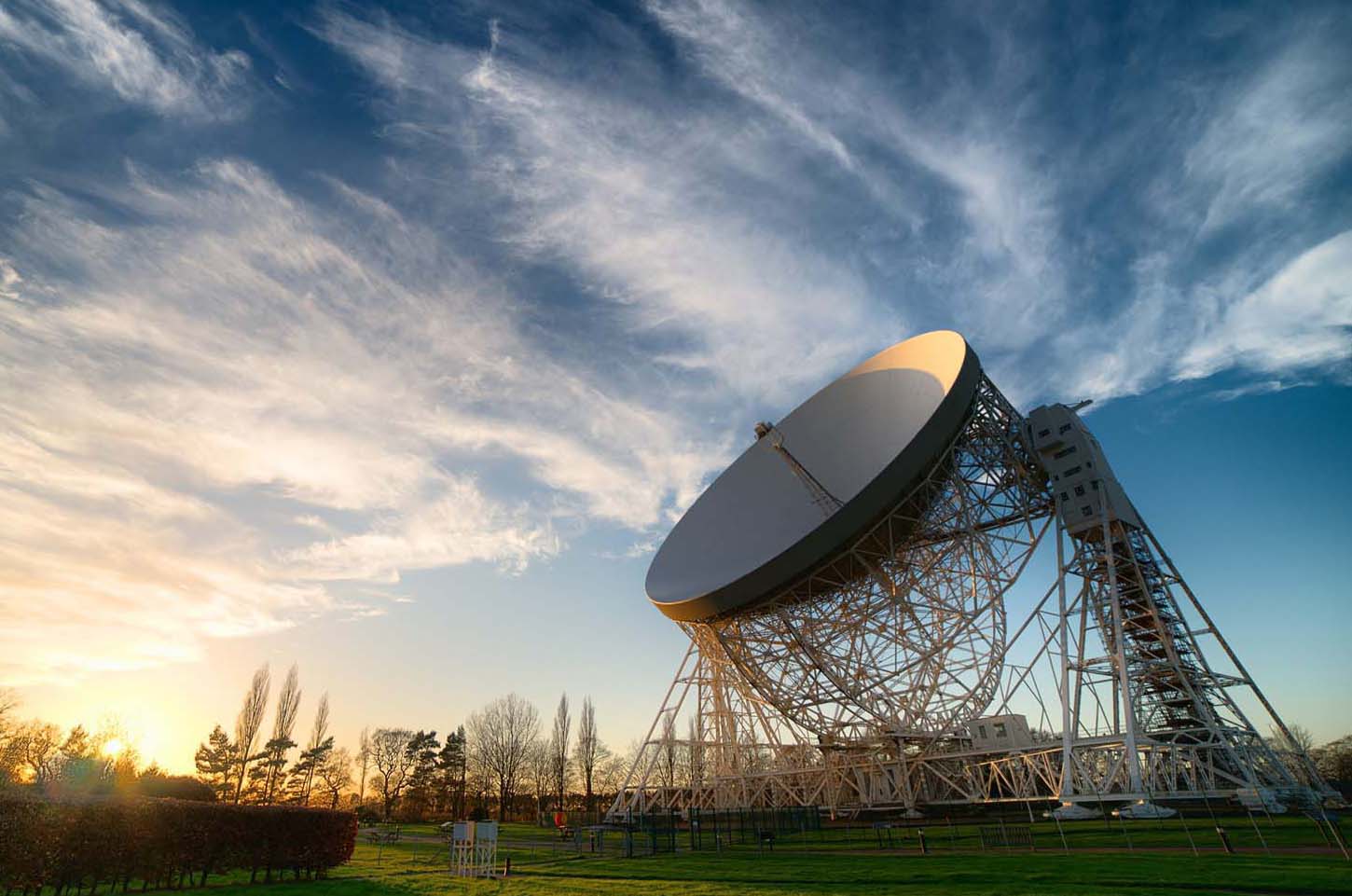
The University of Manchester is “exploring alternative funding arrangements” so it can continue operating the Lovell Telescope, MPs have been told.
Despite PM Andy Burnham telling Congleton MP Sarah Russell that he would make sure the telescope stayed open, funding for the e-Merlin radio telescope network “will not continue” beyond the current agreement, which ends in March 2028, Government whip Jane Ramsey told MPs.
The e-MERLIN – enhanced Multi-Element Radio Linked Interferometer Network project – is an array of seven radio telescopes spanning 217 km (135 miles) across Great Britain connected by a superfast optical fibre network to its headquarters at Jodrell Bank.
Its resolution is comparable to that of the Hubble Space Telescope and it carries out centimetre wavelength radio astronomy.
Other telescopes include the Mark II telescope at Jodrell, Pickmere (Tabley) and Darnhall, as well as Knockin, Defford and Cambridge. It performs two observing cycles a year.
“We firmly support decisions that protect world-leading scientific research and ensure the long-term sustainability of the UK’s research portfolio,” Ms Ramsey told MPs.
Jodrell Bank will continue to serve as headquarters for the Square Kilometre Array Observatory, an international radio telescope astronomy facility. SKAO is to receive more than £300 million between 2021-27, was prioritised over the e-Merlin array.
That budget amounted to £2.8 million, the UK Research and Innovation (UKRI) cutting it because planned research costs for physics and the running of its labs had “escalated”.
Ms Ramsey said in Parliament that Jodrell Bank “is not closing, nor is scientific research on it closing”.
She said the University of Manchester was “exploring alternative funding arrangements” so it can continue operating the Lovell Telescope, one of the seven e-Merlin telescopes.
She said: “UKRI and the Science and Technology Facilities Council (STFC) made a strategic decision to focus resources on the next generation of radio astronomy capability. That decision was taken as part of an evidence-informed process and prioritisation exercise across our research portfolio.”
Manchester University, which operates the telescope, said it was working with its partners to secure the future of the Lovell telescope and e-MERLIN.
Prof Sarah Sharples, dean of the Faculty of Science and Engineering, said: “The university has been working actively behind the scenes with UKRI/STFC and other partners. We will continue to pursue routes with Government, public agencies, industry and philanthropic funders to sustain the extraordinary science, engineering, training and public engagement enabled by Jodrell Bank.”
E-Merlin uses the superfast fibre-optic network so that its telescopes can share data instantly, making them act as one massive telescope as big as the distance between them.
Scientists use it to look at the most violent events in the universe, including black holes, watching new stars and planets forming and studying massive dying stars (supernovae) to understand how they blast material across space.
It can also help track moving human-made satellites, space junk, and near-Earth asteroids to make sure they are not on a collision course with anything important.
The university says that no other existing or planned telescope system, including the forthcoming Square Kilometre Array Observatory (SKAO), can fully replace its role in this research.
The university said that e-MERLIN trains future SKAO users, using a telescope that is operational now, and supports the community of researchers and engineers based around the SKAO headquarters. The university said that restarting e-MERLIN should it close would be “extremely difficult”.
Investment in the SKAO is not the same as funding e-MERLIN or Jodrell Bank Observatory. The SKAO, although headquartered at Jodrell Bank, is a separate international organisation established by treaty and is independent of both the university and e-MERLIN.
Headquartered in the UK on the grounds of the Jodrell Bank UNESCO World Heritage Site, with sites in Australia and South Africa, SKAO is building and operating the two “largest and most complex radio telescope networks ever conceived” to address fundamental questions about the universe.
SKAO’s telescope in South Africa will be composed of 197 15m-diameter dishes located in the Karoo region, 64 of which are already operated by the South African Radio Astronomy Observatory, while the telescope in Australia will be composed of 131,072 two-metre-tall antennas located on the Commonwealth Scientific and Industrial Research Organisation’s Murchison Radio-astronomy Observatory.