
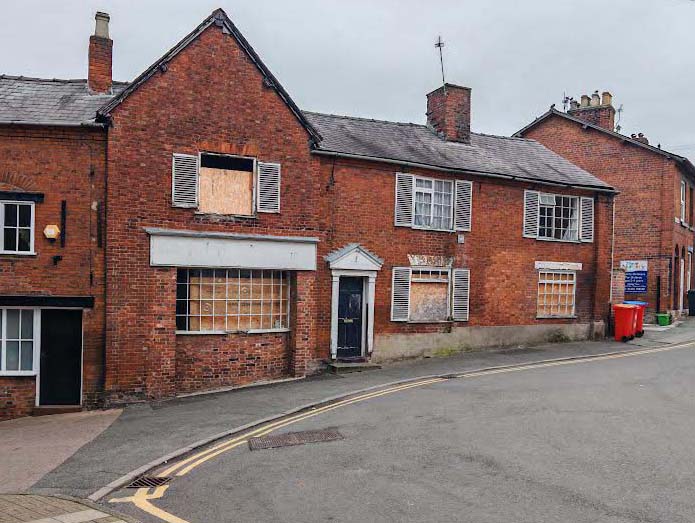
A derelict 16th century building in the “beating heart” of Congleton is to be restored to its former glory, subject to planning approval.
The grade II listed 1, Swan Bank, which was originally a brewery and later became a popular hairdresser’s, is now slated to be transformed into four self-contained flats, to be let out as Airbnbs.
The man behind the plans is master builder Tony O’Reilly, who was keen for the “Chronicle” to hear how he planned to restore the property, if given the go-ahead by Cheshire East Council.
“The building was just crying out to be loved and it spoke to me,” Mr O’Reilly said. “I know that sounds corny, but it was begging for someone to do something with it. It’s in a great location, and there is a severe lack of Airbnbs in Congleton.”
The idea to rent out the flats, he said, came from a bartender at Radley’s, who told him that visitors to the town struggled to find decent self-catering accommodation.
He said: “It went to auction twice and because it’s grade II listed and in such a dilapidated state. I was the only one brave enough, or foolish enough, to take on such an epic restoration.”
Inside the property, he said, there was a “wealth of amazing features”, including traditional oak beams and queen trusses to the gable end on the first floor, which he believed dated back to the latter end of the 16th century.
The auction piqued the interest of BBC’s “Homes Under the Hammer”, which sent a crew to film the first half of an episode that will feature Mr O’Reilly’s restoration once completed.
He said host Dion Dublin had described the project as the “most exciting he’d seen” on the programme.
When asked what attracted him to the property, Mr O’Reilly said: “My father was a master builder, and I’ve been holding up levels and doing extensions to all my own properties since I was old enough to hold a plumb line for my father, God rest him.
“I just wanted to do something that will leave a lasting mark long after I’m gone. I had to clear out all the rubbish that was in there; it’s been derelict and abused for about 20 years.
“I spoke to so many people who walked past and remembered using the hairdressers. They said: ‘Thank God someone is doing something with the building’, because it’s in the beating heart of Congleton.”
Mr O’Reilly said he planned to use grade II specialists Bullen Conservation based in Oldham to complete the restoration and was working alongside the Georgian Group and the Archaeological Association.
However, in documents uploaded to Cheshire East’s planning portal, Mr O’Reilly faced criticism from the groups for a lack of detail in the plans he had submitted.
Dr Thomas Whitfield, senior conservation adviser for the Georgian Group, said he was “severely concerned” that no specification had been made as to how windows in the property would be restored.
He said: “This is a particular concern with the late 19th century bay window, which we note from plans is proposed to be replaced with a flat plate glass unit, dramatically altering the building’s appearance and historic character.
“The group strongly recommends that further details and specifications are needed regarding any proposed works to the windows, and that any replacement units should be of a design which is more sympathetic to the age and character of the building.”
He also highlighted Mr O’Reilly’s plans to demolish a brick stack chimney in the middle of the building, which was believed to date back to the 17th or 18th century.
He said: “We advise that no discussion or justification is offered for this proposal which has a very high potential to cause significant (possibly substantial) and irreversible harm to the building as a grade II listed heritage asset.
“We particularly advise that the loss of this breast and stack will result in the almost total loss of legibility of the building’s historic, possible 17th or early 18th century planform, which must be considered one of its key elements of significance.”
The comments were supported by representatives from both statutory consultees British Archaeology and Historic Buildings and Places in emails to Cheshire East.
The plans also faced objections from a resident living at nearby 1, Wagg Street, who raised several concerns including a lack of parking provision at the site, increased traffic, impact on the nursery next door as well as potential harm to the character of the building.
Another resident highlighted that the original plans had been for five self-contained flats rather than four and argued that a new planning application should be submitted to reflect Mr O’Reilly’s changed plans.
The public consultation period for two separate planning applications for the site ran until Monday.