
Science research money is being spent in the south of England at the expense of the north, a local MP has claimed.
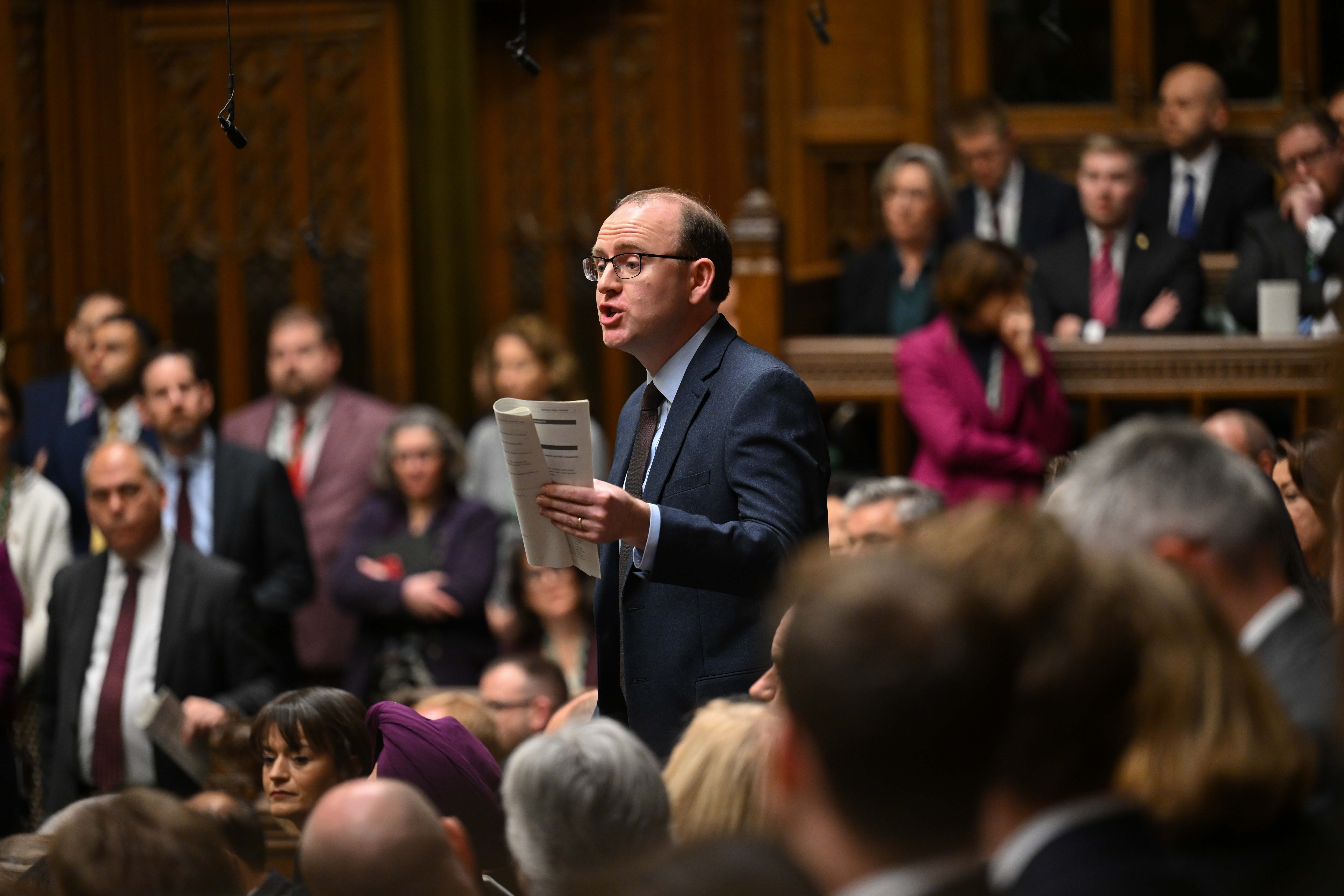
Speaking in the House of Commons, Middlewich MP Andrew Cooper said he was “really concerned” about what was happening to science in the north Cheshire corridor.
“It looks to me like the Science and Technology Facilities Council is circling the wagons around facilities in the south of England at the expense of those in the north.”
Mr Cooper made his comments as other local MPs were raising the threat Jodrell Bank.
As previously reported, Congleton MP Sarah Russell has called for action to address funding cuts that threaten world-leading scientific research at the internationally renowned observatory.
She said that Jodrell Bank faced “a significant problem” in the medium term because of funding cuts, and asked for prime minister Andy Burnham to work with herself, No 10 North and Tim Roca, MP for Macclesfield.
Mr Cooper raised the issue of the Daresbury laboratory, “not too far away from Jodrell Bank”, which had been asked to mothball CLARA — Compact Linear Accelerator for Research Applications — which is a 250-mega-electronvolt electron accelerator, alongside the biology lab that sits above it.
CLARA is one of the world’s brightest medium-energy electron beams and has been designed to develop and test next-generation accelerator technologies, shaping the future of medicine, high energy physics, material science and beyond.
Mr Cooper said the lab over CLARA had never been used, as it has only just been put in.
He asked if a minister was prepared to meet himself and other Cheshire colleagues.
The minister for the future of work Kate Dearden evaded answering. She said she had already mentioned how investment that backed people, facilities and technologies could not only turn research into practical benefits but strengthen the economy and support high-skilled jobs.
“It is vital to keeping the UK at the forefront of global science. The sites across the country are essential to that work, which is why I am proud that the Government have put forward the largest ever investment in research and development, with a record £86 billion to be invested between 2026-27 and 2029-30.”
The Science and Technology Facilities Council recently announced an austerity plan to slice its annual spending by £162 million by 2029–30 due to rising inflation, building repair demands, and soaring energy costs. The council is part of UK Research and Innovation, an umbrella funding body. It has received a record £38.6 billion for use over the next four years, and most fields of science are not earmarked for cuts.
However, the proposed cuts will completely mothball the CLARA electron test accelerator at Daresbury.
The Government has also paused funding for the planned Relativistic Ultrafast Electron Diffraction and Imaging national user facility that was slated for construction at Daresbury, operated by the University of Liverpool. A £125 million national research facility, it would function as the world’s fastest electron diffraction facility and most powerful high-energy microscope for capturing dynamic processes in real time.
Emma Chapman, an astrophysicist at the University of Nottingham, who would be affected by the reduced funding, told “Physics Today” in May: “There is no sugarcoating how damaging the cuts would be for UK physics and astronomy. Groups would close, and early-career researchers would lose their jobs. The UK would lose its footing in current and next-generation international collaborations.”
The UK has already invested heavily in major international facilities, such as the Square Kilometre Array radio telescope at Jodrell Bank, Eloy de Lera Acedo, head of the Cavendish Laboratory’s radio astronomy and cosmology group at the University of Cambridge, told “Physics Today”.
“Cutting domestic research capacity just as these begin delivering data is like buying a Formula 1 car and then not funding the team to drive it. We will still pay the entry fee, but we won’t be competitive, and we won’t capture the full scientific or economic return.”
As well as Jodrell Bank and Daresbury, Boulby Underground Laboratory in North Yorkshire, a world-renowned deep-science facility, is seeing its operational budget slashed by 40%.
This limits its capability to host the prestigious international XLZD dark matter experiment.
The Northern Health Science Alliance reported in 2024 that in 2022, the North received £405 million of research funding, compared to the £1.69 billion awarded to London, Oxford and Cambridge.
It said this equated to “significant discrepancies” in funding per person with the Greater South East receiving over two and a half times more per person than in the North – £68.58 compared to £25.72 respectively.
In the North, Greater Manchester was awarded the most direct funding (£120,730,180 or £42.10 per person) but this was still significantly less than London (£900,808,268 total / £102.37 per person) and Cambridgeshire (£302,210,841 total / £337.85 per person).
The then mayor of Greater Manchester Andy Burnham said at the time: “It’s clear that there’s a stark gap between previous promises made to level up the North and what’s actually been delivered. That a single building in London or the South East can receive more life sciences infrastructure investment from the Government than all of the Northern authorities combined is frankly disgraceful.”