

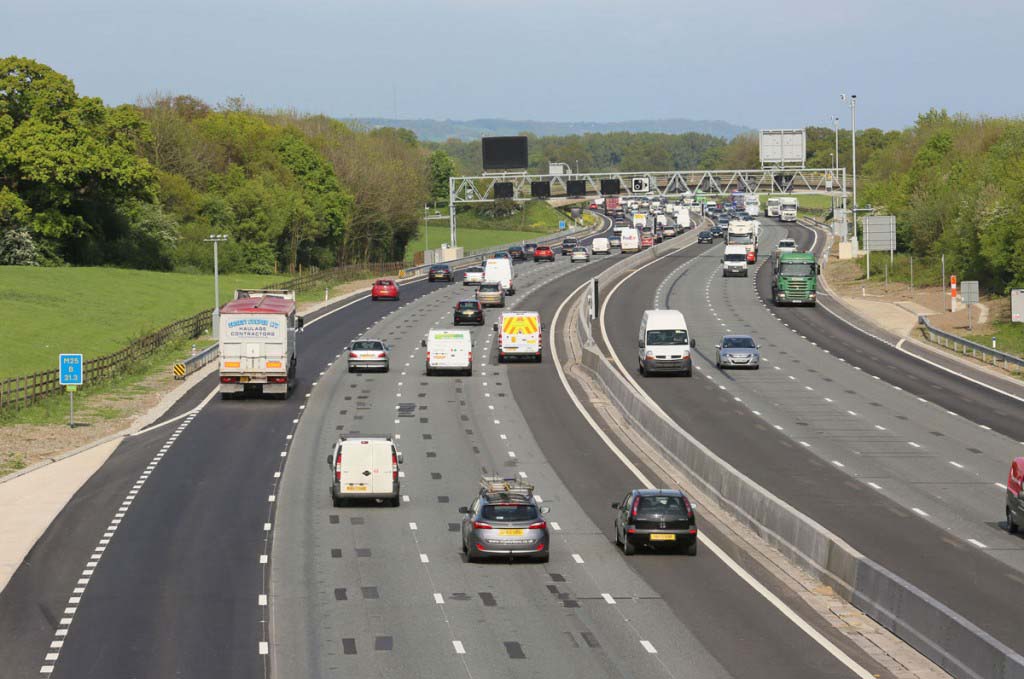
The Transport Action Network, which campaigns for more sustainable transport, has said that the Government’s release of 16 evaluation reports showed that “smart” motorways have been a “costly failure”.
The network, which is calling for all smart motorways to have a hard shoulder reinstated and turned into controlled motorways instead, said that of the 11 five-year-after-opening reports (those with the most data), nine (82%) showed that journey time savings were “significantly worse” than predicted. Most had cost the economy money, rather than generating economic benefits, and the safety results were “mixed”.
Every time a new road project is completed, post opening project evaluation reports are written, after one and then five years. They look at whether a scheme fulfilled its objectives to cut journey times, ease congestion, increase safety and provide value for money.
For the M6 junctions 16 to 19 smart motorway, a 19-mile route, the report said that during the first 12 months of the smart motorway opening, the annual number of personal injury collisions decreased from an average of 94 before construction to 33. This fell below the range of what would have been expected if the road had remained a conventional motorway “and is an early indication that the smart motorway has improved safety for users”.
The report said the route generally experienced “slightly more reliable” journeys for most road users, with marginal improvements to journey time reliability during all time periods.
It said: “In both directions during most time periods, there was a considerable improvement in the longest journey times compared with before construction. However, the longest journeys in the northbound morning peak experienced greater variability one year after opening. Average journey times along the route also improved in both directions, with the northbound PM peak and southbound AM peak experiencing the largest journey time savings compared to before construction.”
XHEAD
Failed
However, the Transport Action Network said the reports failed to show comprehensive figures for people killed or seriously injured to match National Highways’ key performance indicator, so people could judge the real-life impact of the schemes.
The group also had concerns that many smart motorways still had refuges spaced too far apart, and there was no scrutiny of whether in-lane collisions and casualties had increased in the new schemes.
The network’s Chris Todd said: “No wonder Government ministers wanted to sit on these reports. They are a damning indictment of National Highways’ smart motorway programme. They demonstrate that the traffic projections used to justify building these bigger roads are not worth the paper they are printed on.
“They have cost the economy dear, while increasing the danger for people who are unfortunate enough to break down in a live lane. Despite these woeful results, the Government is hell-bent on building more of these much-feared roads. The Lower Thames Crossing is being built to smart motorway standards, with no hard shoulder and the same restrictions as motorways. No amount of denial by ministers will change the reality. As the saying goes: if it looks like a duck, swims like a duck, and quacks like a duck, then it probably is a duck.”
The AA was also not convinced and said that smart motorway anxiety had doubled in a year.
Its survey of 12,705 drivers showed that the proportion reporting feelings of nervousness or anxiety on smart motorways with no hard shoulder — relying instead on emergency refuge areas spaced around three-quarters of a mile apart — has doubled, from 23% last year to 46% this year.
Motorways where the hard shoulder was only opened to traffic during busy periods also saw a “significant” increase in anxiety, with the number of drivers feeling nervous or anxious rising from 30% to 47% in the last 12 months.
By contrast, confidence remained highest on conventional motorways that retained a continuous hard shoulder. While levels of anxiety were still low on these roads, the survey shows a small increase compared with last year, suggesting that concerns about motorway safety may be rising more generally, even beyond smart motorways.
Edmund King, AA president, said: “It’s not surprising that our members are more anxious about using smart motorways. If you break down in a live lane, in effect, you are a sitting duck. The failure of smart motorway technology over the last few years has, no doubt, added to the levels of anxiety.
“What the AA and our members would like to see is the return of the hard shoulder in a controlled motorway environment. Until that concern is properly addressed, it’s hard to see confidence in ‘smart’ motorways recovering.” The AA has raised concerns about smart motorways since their introduction and continues to believe that roads without a permanent hard shoulder should be scrapped.
Between 2010 and 2024, at least 79 people were killed or seriously injured on smart motorways. The AA believes these risks help explain why confidence remains low.
The AA says the findings underline the need for greater transparency and consistency in how motorway safety is assessed, monitored and communicated. While a safety stocktake was published in 2023/24, the subsequent decision to scrap the programme has left drivers unclear about how safety on smart motorways is now being independently reviewed. The AA understands that a number of reports across several stretches of smart motorway, reviewing safety and economic benefits, are awaiting publication — some for years — and is calling for these to be released urgently.
The first trial of smart motorways started 20 years ago on the M42 in the West Midlands between junctions 3A and 7 as a dynamic hard shoulder scheme. This trial evolved into a permanent conversion of the hard shoulder, with smart motorway schemes extended to roughly 17% of the motorway network between 2010 and the cancellation of the programme in 2023.
Nationally, traffic volumes saw a gradual increase of over 5% from 2015. Regionally, there was more variation, with Cheshire West and Chester and Cheshire East experiencing a decline between 2016 and 2017. Staffordshire also observed the lowest growth rate, despite having the highest level of traffic volumes at the start of the project works in 2016.