

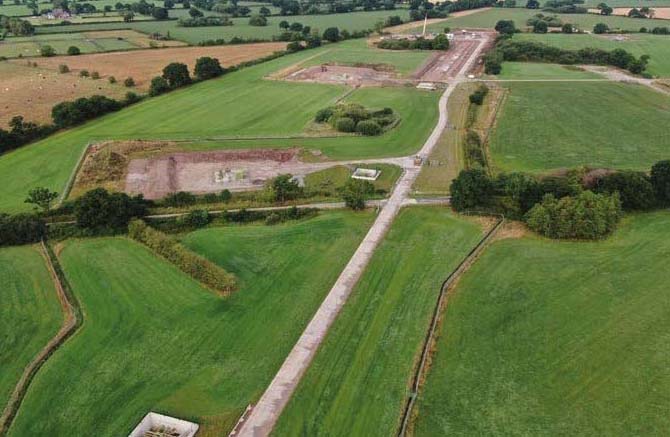

Residents are worried that an underground gas storage facility could leak and cause a “major explosion”.
A public consultation has been launched about the type of gas that can be kept in 19 salt cavities earmarked for construction on the Holford Brinefield at Byley, near Holmes Chapel.
The move comes from pressure on the Government for the country to have more access to energy-efficient hydrogen, as part of its bid to achieve net zero by 2050.
The Keuper Gas Storage Project was given the go-ahead by the secretary of state for the Department of Energy Security and Net Zero in March 2017, without the need for it to go through standard local authority planning processes.
While it had been earmarked to hold 500 million standard cubic metres of natural gas, the project developer has now applied for a non-material change to allow for the storage of 1,300 gigawatt hours of hydrogen – “more clean energy than any other facility and enough to power the city of Liverpool for 22 weeks”.
The Keuper Gas Storage Project is being developed in partnership between INEOS Inovyn and Storengy UK. Keuper Gas Storage is the project developer. Storengy UK is a subsidiary of ENGIE, who developed and now operate the Stublach Natural Gas Storage site near Middlewich. Now fully completed, the scheme is the largest on-shore gas storage facility in the country, enhancing the security of supply to the UK gas market.
Informed
Cranage resident Joan Wilde said she could not believe residents had not been informed about the plans.
She said: “Not a lot of people know about this, and it is quite scary. Something like this has been planned since 2017 and nobody had an inkling about it. We need to get it out into the public domain to as many people as we can.
“It is going to cause so much traffic on the roads and disruption for 10 years while it’s being built. I’m really speechless and worried for safety; it’s frightening.”
Holmes Chapel Parish Council also has safety concerns about the hydrogen storage plans.
Mrs Wilde was in a group that campaigned against the construction of seven underground gas storage facilities near Byley in 2004.
She said: “There was a public enquiry, and two inspectors said it was completely inappropriate to put it in a built-up area because it was so dangerous.”
The group raised £30,500 for the campaign, which was ultimately taken to the High Court.
The plans were rejected following a public enquiry, but the decision was overturned by then deputy prime minister John Prescott in 2004 and construction went ahead.
Mrs Wilde said: “We couldn’t argue with Mr Prescott. The judge said we’d run a good campaign, but his hands were tied and he couldn’t help us; he was so genuine.” As part of the group’s research, they came across The Hutchinson Disaster – two major explosions that took place in Hutchinson, Kansas, in 2001, caused by a gas leak from an underground salt mine.
In that case, natural gas stored underground at the Yaggy storage field near Hutchinson leaked into empty brine caverns and salt wells, resulting in two gas explosions.
In the first explosion, a shop was destroyed, and 26 other buildings were damaged in the blast. Only minor injuries were sustained, but by the evening several sinkholes had opened up across the city, with jets of water and gas reaching up to 30 ft.
The following day, another explosion in a trailer critically injured two people, who later died from their injuries. More than 200 families were evacuated from their homes.
Mrs Wilde said: “Unbelievably, this is the same thing that they’ve already built here, and now they’re wanting to turn those seven into 19!
“They say it won’t blow up, but how can they know something won’t happen with the valves? Something could stick, and the whole area could go up, just like that.” As part of the public consultation, a report into the potential hazards of the project has been published on the Keuper Gas Storage Project website.
It said: “Ignition control measures are implemented across the proposed development to reduce the likelihood of fire or explosion.
“These include hazardous area classification, control of portable ignition sources such as lighters and mobile phones and the use of anti-static PPE.”
During the construction phase of the project, it said specific measures would be in place to manage risk associated with major accident hazards.
It added: “An emergency plan will be developed to address potential on-site consequences. The plan will include procedures for managing ignition sources, hazardous activities, and emergency response.
“Personnel will be trained in emergency procedures, and regular exercises will be conducted to ensure preparedness.”
A public consultation meeting was held at the De Vere Hotel in Cranage last Wednesday.
Full details for the plan can be found at kgsp.co.uk. The last date to submit a comment on the consultation is Monday, 20th November.
Holmes Chapel Parish Council was notified by Keupers Gas Storage about the consultation, which was on the agenda at a recent meeting of the council’s Strategy and Finance Committee.
The information mentioned that among the proposed changes to the plans approved in 2017 is the construction of a 50-metre flare instead of a vent.
Link
The company said that if given the go-ahead, the hydrogen storage facility would link to HyNet North West, the regional hydrogen and carbon capture network and would be the largest of its kind.
Minutes from the parish council meeting show it was resolved to respond with questions about the safety surrounding storing hydrogen and its volatility versus natural gas, and ask that this is investigated when the application is considered.
In a newsletter explaining the plan, the company said: “Hydrogen is a game-changing source of energy that can be used as both a raw material for industry and as a clean power source for transport, industry, business and electricity generation when the wind isn’t blowing and the sun isn’t shining.
The North West is seen as a key location for hydrogen production and carbon capture, due to its natural assets and established, energy intensive industries that need to cut their carbon emissions.”
The company promises a community benefit fund similar to the funds previously in place for the other existing gas storage projects at the Holford Brinefield. A total investment of over £400,000 across 10 years of construction will be available.