
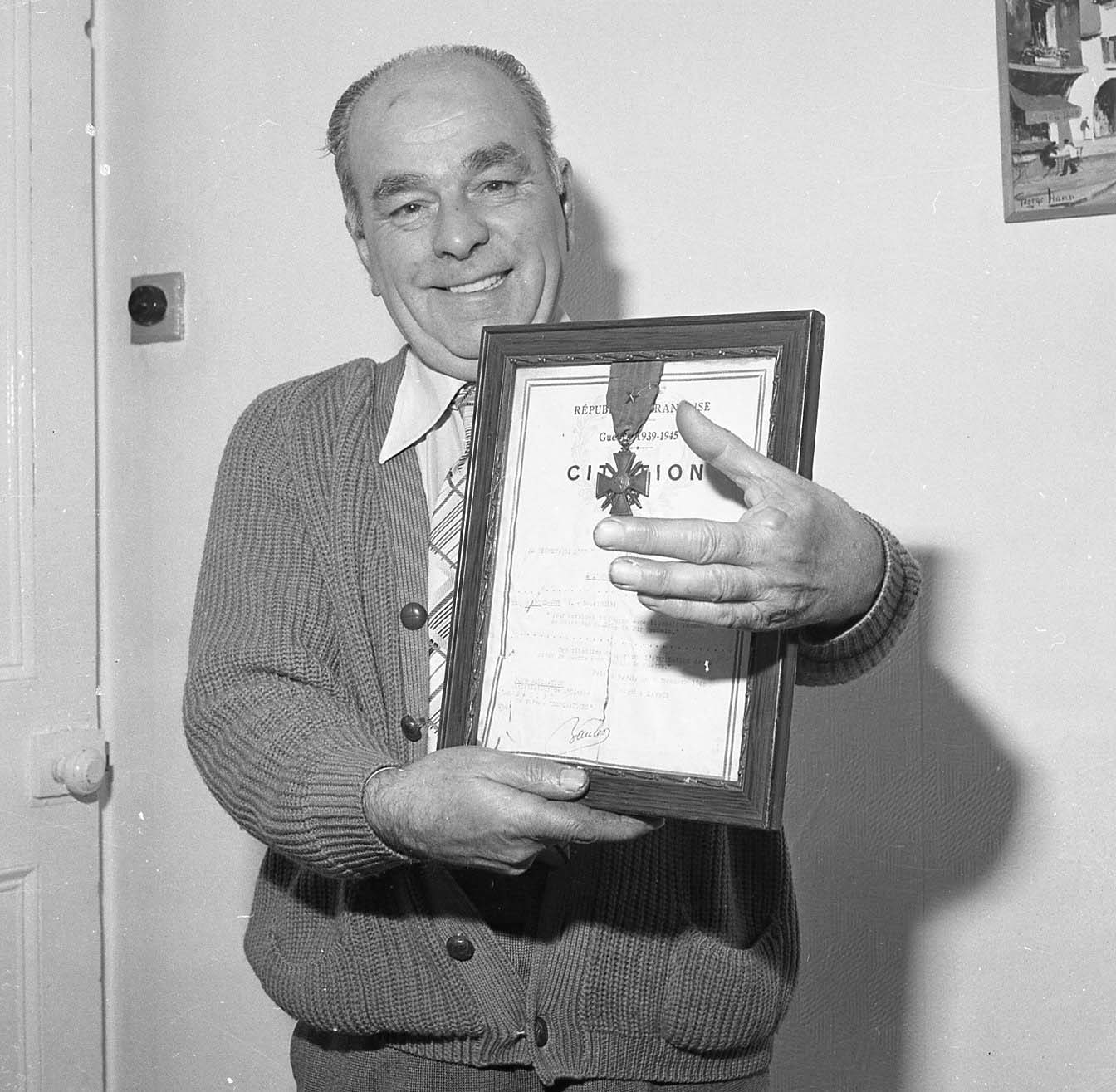
The tale of the soldier who had a finger amputated three decades after World War II took a twist this week after it emerged that the injury had been removed from his army record.
As we reported two weeks ago in our “Chronicling the Past” section, in 1976 former soldier Wilfred Cartwright, who fought in North Africa in World War II, had had his left index finger injured when he was hit by flying shrapnel.
It was treated and, although he could not bend it, he retained it until 1976, when it was amputated – 32 years after the injury.
Mr Cartwright, then 61 and of 25, Swan Street, Congleton, told the “Chronicle” that at the time the doctors did not think it needed removing.
“I’ve never been able to bend it properly, and it’s given me a bit of trouble now and then, but I didn’t think I would lose it until I got an infection in it last year,” he told us in 1976.
“The doctor at the War Memorial was more concerned about me losing it than I was. It was so much bother that I just wanted rid of it. If I’d been a younger man, I suppose it would have upset me, but it’s not that big a thing now.”
We followed this up last week with a report from his daughter Diane Booth, who provided more information, and details on the medal we had pictured him with in 1976, the French Croix de Guerre.
She said she assumed her father would have originally been in the Cheshire Regiment in WW2, but said most were wiped out and “the stragglers were placed in the French Foreign Legion”.
She said: “He was not very happy there, and when volunteers were asked for to join the Free Fighting French, he volunteered immediately, working alongside the French Resistance.
“It was at the battle of Bir Hakeim, where my father, a gunner, found himself and his comrades surrounded and strikes coming from above as well. Despite firing as much as they could, it wasn’t making much difference.
“His friend next to him was upset and pulled out a photo of his wife and new-born baby back home, and said to my father: ‘We are not getting out of here are we? I will never see my new-born son or wife again.’
“Dad said: ‘Of course we will, we are going to get through this,’ then enemy fire hit them, killing his friend and leaving shrapnel in my father’s head and his finger blown away.
“He was so cross that he started to fire the gun madly at the enemy.
“There were some survivors, my father being one. At the field hospital, an officer was being seen by a surgeon and seeing my father, he attended to his finger as well. It stayed in position until the date of your article.
“My father always said there was no glory in war.”
Missing
She went on: “He was never a great letter-writer and home had been informed that he was missing presumed dead.
“Apparently, when he came home and let himself in, his great-aunt fainted in the hallway – she thought she had seen a ghost!
“He tore up his citation for his medal, which later was Sellotaped back together and put in the frame with the medal.”
Bir Hakeim, in the Libyan desert, was the site of a pivotal World War II battle (May–June 1942) where the 1st Free French Brigade under General Marie-Pierre Kœnig held off superior German and Italian forces for 16 days.
The Free French forces, surrounded by Erwin Rommel’s Axis army, successfully delayed the enemy, allowing British troops to regroup. This heroic stand, often referred to as a turning point for morale, resulted in significant Axis losses.
The citation for Mr Cartwright’s medal explained: “While attached to the Free French, Gnr Cartwright was a 25-pounder gunner in one of three isolated mined pockets of resistance in the path of the German advance.
“Two of the five gunners were killed by shrapnel and dive-bombing attacks, and Gnr Cartwright and the other two were wounded.
“Despite their wounds, and with ammunition running out, the three remaining gunners kept the gun in action, and the attack was kept at bay until reinforcements arrived, and forced the enemy to retire. The Free French Force, amounting to about a brigade in strength, was almost completely wiped out in the action.”
However, unsure of Mrs Booth’s recollection – or her father’s own memory – that the Cheshires had been wiped out and the stragglers joined the Free French, we contacted the Cheshire Regiment Museum, whose Geoff Crump BEM, a volunteer researcher, delved in Mr Cartwright’s war record.
He said that Mrs Booth assumed correctly that her father had originally been in the Cheshires, although not all men from the county of Cheshire ended up within the ranks of the Cheshire Regiment.
Mr Crump explained that in 1921, after the Great War, the whole of the British Army was re-numbered, with each regiment being assigned a unique block of numbers that were to be issued to soldiers enlisting directly into that regiment.
If the soldier was eventually transferred to another regiment, he retained the service number he was given when he first enlisted.
The Cheshire Regiment received a block number in 1921 beginning with 4114001 and ending 4179000.
Mr Cartwright was issued army number 4131534, which falls into that block of numbers and confirms him having originally enlisted into the Cheshire Regiment.
However, he was not with the Cheshire Regiment for long and is noted as having been transferred to the Royal Artillery on 9th November 1940.
Just over 100 men who were in training were transferred to the 61st Anti-Aircraft Regiment of the Royal Artillery.
He said Mr Cartwright applied for his WW2 Campaign Stars and Medals. On his record card, produced by the War Office, his address was recorded 58, Swan Street, Congleton, but his army unit was shown on the card as being the 2nd Battalion of the Cameronians and his rank is shown as Rifleman.
The 61st Anti-Aircraft Regiment Royal Artillery was broken up in the Middle East in 1944 with personnel being sent to infantry units, which must be when he went to the Cameronians.
His army number remained 4131534, and he was discharged from the army as a Class A Reservist on 18th January 1946.
The 1939 register records that Mr Cartwright was a silk textile weaver.
Mysteries
There now remain two mysteries: Mr Crump said he had checked online for an award of the Croix de Guerre and could find no mention in the “London Gazette”, which lists all awards, although in a follow-up email he said he did not dispute that Mr Cartwright received the award.
More mysteriously, Mr Crump wrote: “Searching various records available to us, he is shown on WW2 casualty lists as being wounded on 26th June 1942 while serving in the Middle East.
“Strangely a later list records that the entry should be deleted and he was listed in error. We cannot say why this occurred.”
The “Chronicle” was hoping we could find a dramatic twist to this story – why was an injury was removed (albeit unsuccessfully) from his records?
A quick Google shows the nascent SAS was operating in the Bir Hakeim area at the time … but sadly for a dramatic tale, so was the 61st Light Anti-Aircraft Regiment, which was providing air defence in the vicinity of the Battle of Bir Hakeim in June 1942.
And looking for trivial news angles would only detract from Mr Cartwright’s bravery in a desperate battle.
A military website notes that the French defenders at Bir Hakeim were the first to fight the Germans since the fall of France in 1940, and their efforts boosted French pride after the defeats of 1940 and proved that France was still in the fight.
The Free French proved their worth, resisting with the “utmost gallantry”, as Winston Churchill told the House of Commons at the time.
After earlier skirmishes were repulsed, General Rommel realised that the Bir Hakeim outpost was holding up his overall attack, he deployed the Luftwaffe, artillery, and German tank and infantry forces to take the position – but still the defenders, including Mr Cartwright, held on.
Outnumbered, outgunned and almost cut off but supported by the Desert Air Force – and David Stirling’s SAS, harrying German troops in the desert – the French fought on until the night of 10th/11th June when, almost out of ammunition, they were withdrawn with the help of Royal Army Service Corps drivers in trucks and ambulances.
A heroic tale, and only retold because we found a photo of a man with half a finger!