
Top bosses from a group planning to build the “biggest pipeline the UK has seen in 60 years” through Cheshire and Staffordshire have faced questions from the public over its safety.
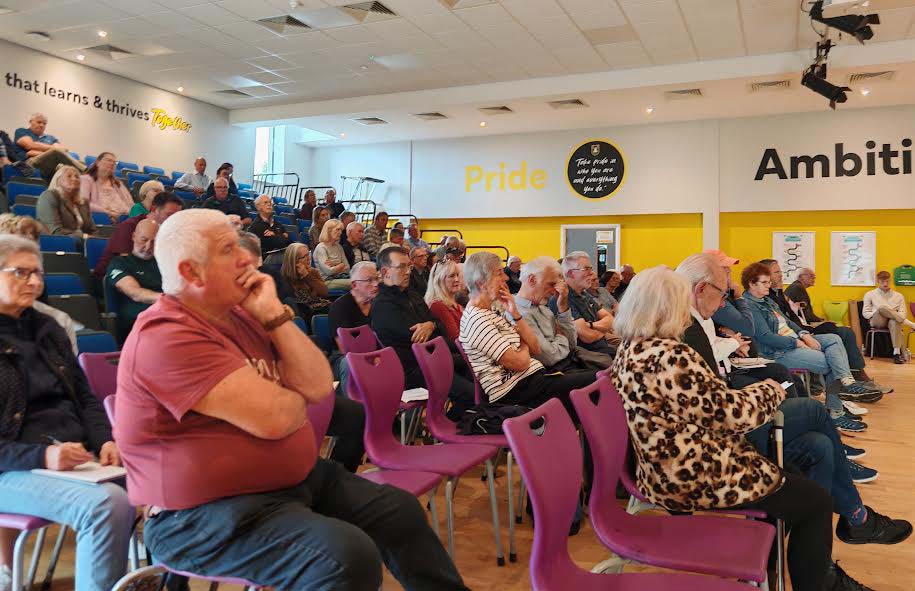
Residents from across the borough packed into a meeting hall at Holmes Chapel Comprehensive School on Monday 21st September to hear from the chief executive of Peak Cluster – a partnership of organisations working with central Government on a £5 billion carbon capture project.
It will see a 125-mile steel pipe buried to a depth of 1.2 metres, stretching from cement factories in the Peak District, through parts of North Staffordshire and Cheshire and across to the Wirral where it will enter the East Irish Sea.
The meeting was organised by Congleton constituency MP Sarah Russell, who, as we reported, in July, told a Westminster Hall meeting that residents did not feel “engaged”, like they did not have “a voice” or enough information on the project.
She invited Peak Cluster’s chief executive officer David Parkin and engineering manager James Glass to clear up confusion and answer questions from the public at Monday’s meeting.
Introducing the reason for the scheme, Mr Parkin said: “We wouldn’t be here if the planet wasn’t getting warmer, so this is fundamentally a climate project.”
He explained that the UK had halved its carbon emissions over the last 30 years by decarbonising the electricity sector, shutting down power stations and investing in renewable energy.
“We’ve also shut down a lot of the UK’s industry,” he said.
“Steel, fertiliser, chemical – but we’re still using a lot of those products, we buy them from overseas. The carbon isn’t sitting on our accounting books, but we are still utilising a lot of it.
“With Peak Cluster, we are trying to decarbonise British industry and reduce our carbon footprint in the UK, while still maintaining our manufacturing presence.”
Mr Parkin explained that the pipeline would capture CO2 from cement factories at Hope in Derbyshire and near to Batham Gate in Staffordshire.
Using a chemical engineering process, CO2 would be stripped out of the gas currently being released through large chimneys and put into the pipeline for transportation.
He said: “Each of these factories has a large chimney; some of them are producing one million tonnes of CO2 a year, which is a huge amount.
“Carbon capture storage is widely accepted as being the only viable mechanism to decarbonise at scale.”
Describing how the pipeline would be laid into the ground, Mr Glass said topsoil from a section of the field would be stripped away, to keep it separated from the subsoil. The pipeline would then be dropped into the trench and connected, before being recovered with subsoil and then topsoil, before it was “handed back to the farmer”.
He said: “To do that we need about 30 to 40 metres of space – it sounds like a big strip. That is to allow us enough room for safety but also so we can build it quickly.
“Pipelining is a summer sport; we would expect to be starting in April and be finished by October for any individual section.”
Mr Glass admitted that it would cause additional traffic on the roads.
“You can’t build something this big without a level of traffic,” he said.
“One of the reasons we have a working width of 30 to 40 metres is to try and keep construction vehicles off the road network so that they can travel the length of the pipeline. When we’ve closed one section, we can move to the next one.”
He said the plan was to stick to A-roads and motorways as much as possible and that additional slip roads would be built to allow the vehicles to get to site with as little disruption as possible.
First question
The first question of the meeting came from a resident who referred to a carbon capture project in Denmark, known as Syvtallet, where carbon was being converted into a liquid and transported to the German border in tankers.
She asked: “Why are we having a pipeline here when in other areas they are doing things quite differently?”
She also questioned why the Danish project was only costing £150 million, when the estimated cost of Peak Cluster was £5 billion.
Mr Parkin explained that the scale of the Syvtallet project was “much smaller”.
He said: “You can transport CO2 as a gas or liquid. The vast majority of gases in the UK are transported by pipeline because it is generally much more efficient and with lower environmental impact.
“If we tried to transport three million tonnes of CO2 as a liquid in tankers, or along railways, you’d be talking thousands of vehicle movements a day, or you’d need a new railway line all the way across the Peak District.
“At this scale, pipelines are an order of magnitude more efficient.”
Mr Parkin explained that no new homes could be built directly over the pipeline.
One resident asked if the route would interfere with the construction of the Middlewich Eastern bypass, which was part intended to open up land for developers to use for industry according to Cheshire East’s Local Plan.
Mr Glass explained that tunnels would be used to get under larger roads, such as the M6 and the newly built bypass, as well as waterways including the River Dane.
He believed that the industrial land earmarked ran between the bypass and the town but said it did not take the same route as the pipeline so it should not interfere with any future construction.
Addressing safety concerns, Mr Parkin said the UK had around 27,000km of high-pressure gas pipelines already running underground. He said the Peak Cluster project would be regulated in “exactly the same way” and that the UK had an “exemplary record” of safety.
“Absolutely, there are hazards associated with transporting compressed CO2 in a pipeline,” he said. “There are hazards associated with transporting any gas in a pipeline. The UK knows how to design, build, operate and maintain pipelines. It’s essentially a safe technology. A lot of the risks associated with natural gas are the same as CO2.”
Mr Parkin said there was already considerable underground pipe infrastructure in the Cheshire region, which was built in the 1960s and 70s, including one of the UK’s largest natural gas pipelines, which runs from Scotland across the country, transporting “vast amounts” of gas at high-pressure.
He said: “We need to demonstrate to the Health and Safety Executive that the risk which we are putting out there as part of our pipeline is in line with acceptable societal risk levels.”
Leak
One resident asked: “How would people know if there had been a leak, or understand that they should stay away from the area if there was? “Is it true that it is automatic asphyxiation if you do happen to wander into a pocket of this vapour?”
Mr Parkin explained that a major accident prevention document was being developed, which was in the “very early stages”.
He said: “There has been no major pipeline incident in the UK in the last few decades that I’m aware of, and they are very well recorded.”
Mr Glass said it would depend on the scale of the leak.
He said: “The compression of this gas is about 20 times what’s in your car tyres. If it’s leaking, you will know about it and everybody within a large radius would see it.
“This is catastrophising, but if it’s big enough to worry about, you would know about it because you would hear it and see it.”
He said that corrosion along the pipeline over time was monitored with a sensitive fibre cable run along its length to “listen” for the slightest defect. Workers could then be sent to dig up and repair the pipe.
Many of the concerns were about the construction of an above ground installation (AGI), which Mr Glass explained was an area where the pipes came to the surface in order for them to be checked and maintained.
While an early version of the map previously uploaded to the Peak Cluster website showed the AGI covering a large area, he explained that it had only been to indicate the general area in which it would be built.
To get an idea of the look and size that the AGI would be, Mr Parkin urged residents to look out for a natural gas AGI situated on land to the left of the M6 junction 18 slip road.
He stressed that the construction at the site would not have any moving parts and would therefore make no noise.
He also said it would not be permanently lit.
He could not reveal precisely where the AGI would be located because talks were still ongoing with the landowner. He insisted that it would be the only AGI required in the area.
Cheshire East councillor Sally Holland (Congleton East) attended the talk to ask questions on behalf of residents living in her ward, which includes Timbersbrook, where, as we have previously reported, landowners had been some of the first to hear about the project.
Coun Holland said: “Is there an intention to transport CO2 from other organisations or even countries through this pipeline, because I have heard several rumours.”
Mr Parkin said this was one of the questions he was asked most often.
He said: “There are early-stage concepts of importing CO2 from Europe into Merseyside. This is something which the UK Government has been pursuing for some time.”
Norway and the UK, he said were the only two countries in Europe that had the capacity and geology to store “vast amounts” of CO2.
“The Norwegians are already doing this very well,” he said.
“The UK has just signed an agreement with Belgium to look at transporting some CO2 from there into the North Sea. If everything plays out, there may be an opportunity to look at taking carbon from Ireland, for example.
“Overall, it would reduce the cost to the UK taxpayer and reduce the amount of CO2 in the atmosphere, which can only be a good thing, but we are a long way from any of that happening, at least a decade.”
Coun Holland said: “What should I tell the farmers in my ward who believe their farms are in jeopardy? I’m being told it’s 20 to 30 years to get that land back to being fit for agricultural use, especially for dairy farmers.”
Mr Glass explained that most of the pipeline was being run through agricultural land to reduce its impact on towns and more urban areas.
He said: “There is definitely an impact to farmers. In the short term there will be a large amount of disruption if you own a field in the path of the pipe.
“There is a level of compensation due to farmers for the temporary disruption and then also for any permanent restrictions, for example them not being able to sell the land to a housing developer.
“All pipelines are built in the same way. Most pipelines sit in farmers’ fields; most farms haven’t gone out of business as a result of a pipeline being built in those fields, it’s just been a long time since the UK has built a lot of pipeline, and this will be one of the biggest schemes that the UK has seen for around 60 years.”
A phase one public consultation on the scheme is due to start in November, followed by a second phase consultation which they believed would be towards the middle of next year.
More information, including an interactive map detailing the route of the pipeline, can be found at peakcluster-consultation.co.uk