

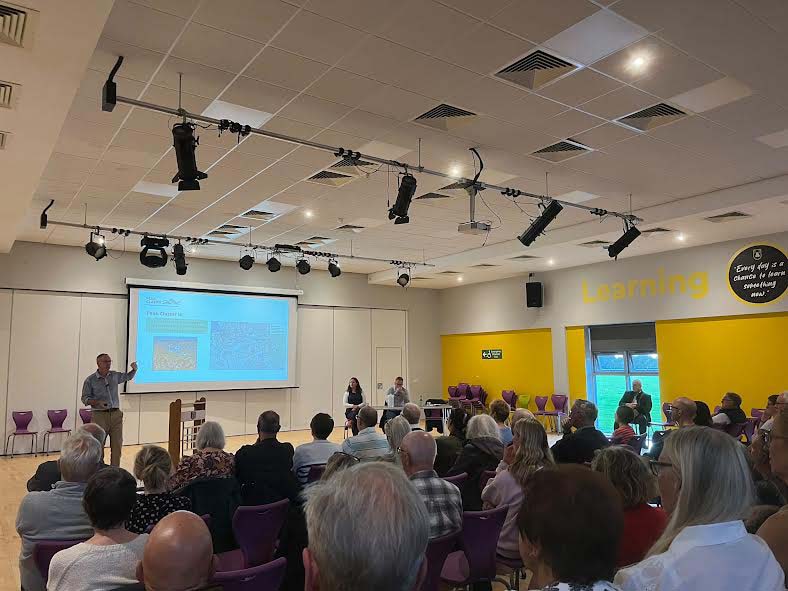
Questions about a 125-mile pipeline that will run through Cheshire and Staffordshire were answered at a meeting with top bosses from Peak Cluster.
As we reported in last week’s edition, chief executive officer David Parkin and engineering manager James Glass, faced the public at a meeting organised by MP Sarah Russell to help them understand more about the pipeline.
At the event hosted at Holmes Chapel Comprehensive School, Mr Glass explained that one section of the route had changed since the original map was published online.
Due to the “unknown” geology of brine caverns to the south of Middlewich, the pipeline had been earmarked to travel to the north of the town during the early planning stages, running first between Holmes Chapel and Cranage.
He said: “We have since done a lot of geological work and had conversations with the Brine Compensation Board and the British Geological Society. I am now no longer concerned about the geological risk caused by historical brine extraction from those salt deposits.
“From the consultation, this route around the north of Holmes Chapel clearly had an awful lot of feedback, and so we are now able to take a slightly different route around the south of Middlewich.”
The full route for the pipeline, which will start at cement factories in Hope, Derbyshire and near Batham Gate in Staffordshire, will run around the north of Leek and between Rushton Bank and Rudyard, skirting over the north of the reservoir.
It will then run through Timbersbrook, crossing Weathercock Lane and Pedley Lane, before heading through North Rode.
Just outside Marton, the pipeline splits running north-east towards Derbyshire and south-west towards the north of Swettenham, before heading south just before Holmes Chapel and continuing to the south of Middlewich and north of Elworth.
One resident, who said he worked as a planning specialist before retirement, questioned why the pipeline route travelled around Bosley Cloud and passed just to the west of a central “hub” of walking trails in the Timbersbrook area.
He said: “It’s a tourist picnic site and car park area, which is heavily used and busy at the weekends. It strikes me that the routing assessment should have been more sensitive to that.
“Has the risk to human life been taken into account in the choice of that part of the route?
“If there were to be a leak in that section near to the Cloud, the gas would flow upwards and be retained there, and you’d get a belt of gas running near to where the housing is.”
Mr Glass responded: “In time there will be a much larger explanation of how we’ve arrived at the routes we’ve decided on.”
He explained that running the pipeline to the north of the Cloud, would have involved construction through “hillier terrain”.
“Building pipelines into hills is more difficult in the short term and poses other geological land movement risks in the long term,” he said.
“We will justify that routing process in more detail, but we need to take into account environmental, topographical and practical considerations, people and logistics of getting vehicles to site. There is always a balance.”
Impact
Addressing concerns about the environmental impact of the pipeline, Mr Parkin explained that, as part of the Government’s framework for the scheme, Peak Cluster had to demonstrate a biodiversity net gain of at least 10%.
He said: “We have ecology surveyors going out counting all the hedges, all the different habitat types and ponds for example, so if as part of this project we have to take out 10 metres of hedge, we have to put 11 metres back.
“We have to hold that standard for 30 years and demonstrate that to the local authority.”
Mr Parkin said it was “standard practice” to build pipelines through green belt land.
He said: “There is a new jet fuel pipeline currently being built between Southampton and Heathrow, which runs all the way through South Downs National Park.
“Absolutely, pipelines can be laid through there if you restore it back to its original state.”
An “extensive” environmental impact assessment, he said, would be completed and made available to view online, including the effects on traffic, noise, biodiversity and ecology.
Assessments for other carbon capture projects across the UK, including HyNet North West and East Coast Cluster, were already available to view.
“We do understand that there are concerns about us coming onto people’s land,” Mr Parkin said.
He explained that the project was in the first of a two-stage process of engaging with landowners, to allow access for undertaking surveys to build up a picture of obstacles the pipeline may face.
He said: “When we actually want to go ahead and build, we will need to have a long-term agreement in place with the landowner to secure access for us to maintain the pipeline.
“We aim to do that through a voluntary process called an easement, which is a legal instrument which gives us long-term lease of the land, giving us access to inspect the pipeline if we need to, but the land gets handed back to the farmer for use.
“If at the end of this process we can’t secure that voluntary agreement, the planning process does give us compulsory purchase rights. It’s not something any project wants to utilise; we will do our utmost to secure voluntary agreements where possible.”
Failing
One resident took statistics to the meeting which suggested that the UK cement industry was “failing”.
He said: “Why is so much money being spent supporting a failing industry, which it will be.
“If you look at the figures for the UK in 1990, we produced 15 million tonnes of cement; in 2024 we produced seven million tonnes.
“Number 14 in the world is South Korea, which produced 50 million tonnes of cement. Does this not make the pipeline redundant before its already started?”
Mr Parkin said: “The first carbon storage project I ever worked on was for a fertiliser plant in Cheshire which closed. There was another one in Teesside, which closed.
“The UK now buys all of its fertiliser from abroad, through the Strait of Hormuz – and look at what’s now happened to food prices in the UK.
“There is a broader question around the UK’s sovereign industrial capability, and I think it’s a good thing that the UK continues to make its own cement.”
He added: “We are currently importing about 30% (of our cement), which has grown quite significantly, putting the UK industry under threat. If we have the ability to produce low carbon cement used in UK projects, that will secure the long-term future for this industry.”
One Timbersbrook resident questioned how much the UK could impact climate change overall.
She said: “The UK produces less than 1% of worldwide CO2 emissions. The Peak Cluster pipeline aims to collect less than 1% of UK emissions. Why bother?”
“We get asked this quite a lot,” said Mr Parkin.
“Globally, 38% of emissions come from countries that produce less than 1%. If none of us did anything, we wouldn’t tackle climate change at all.”
He said the same argument could be made in asking individual households to recycle.
“Whether I do my recycling or not makes very little difference,” he said.
”If my entire village, town or county doesn’t do its recycling, it will start to make a big difference.
“All but two countries in the world, the US and Iran, are doing what they can to tackle their own emissions, many of which are carbon capture projects.
“It’s important that every society looks to reduce their emissions for the benefit of the world more broadly.”
A six-week public consultation on the next phase of the project is due to be launched in November.
More information, including an interactive map of the pipeline route, can be found on the Peak Cluster website.
(Photo: Sarah Russell).