

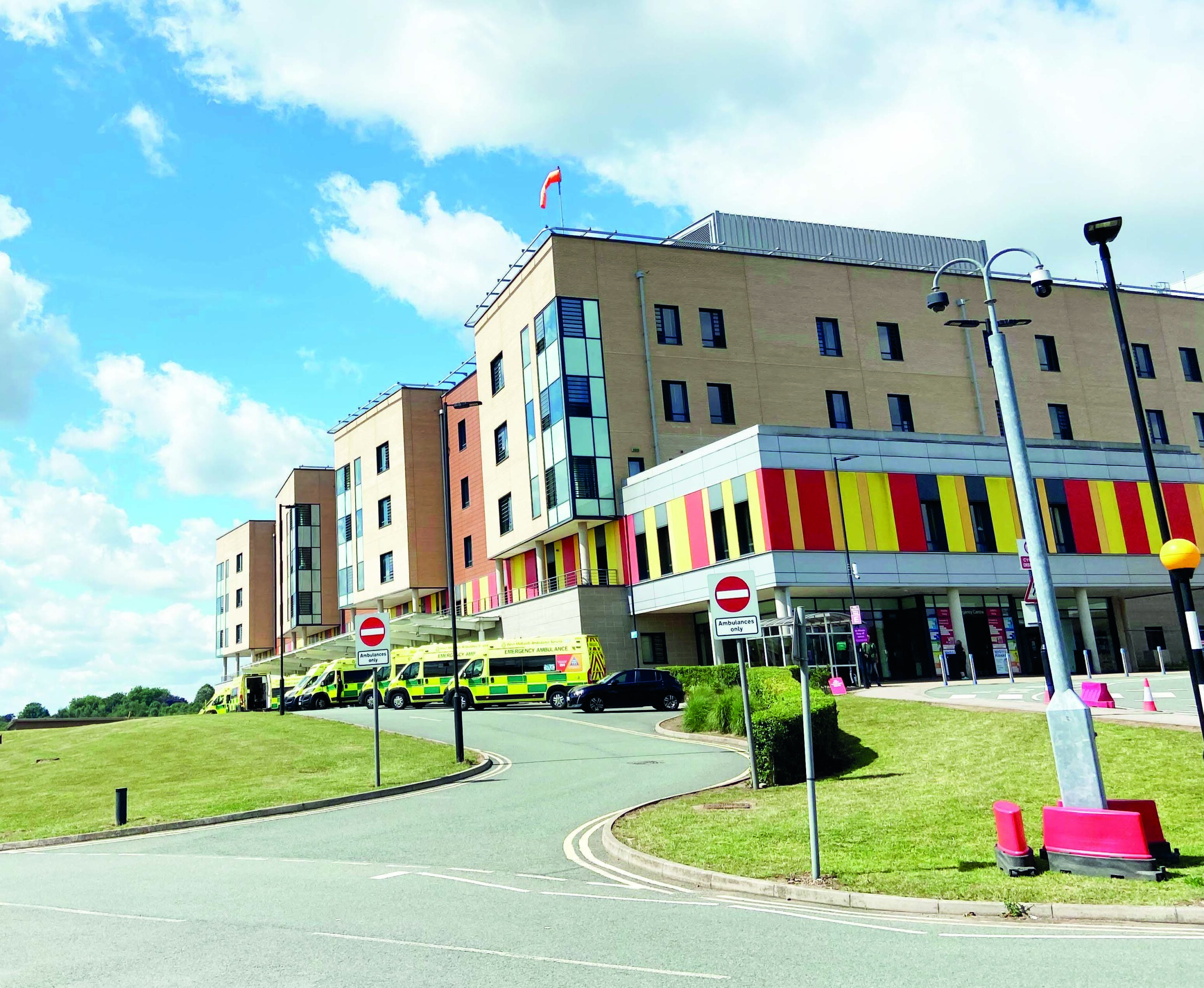
Winter pressures are hitting Staffordshire’s main hospital trust earlier than expected, with 50 patients with covid now taking up beds.
As a result, ambulance handovers at University Hospitals of North Midlands were taking an average 78 minutes at the end of September, compared to the national standard of 15 minutes, (writes local democracy reporter Phil Corrigan).
University Hospitals of North Midlands NHS Trust bosses said there had been a “sharp increase” in respiratory viruses, including covid, flu and RSV (respiratory syncytial virus), while actions aimed at improving performance have not worked as well as hoped.
They told a board meeting that performance metrics showed that winter conditions had effectively arrived around a month earlier than expected.
The trust is now having to update its action plan in order to get back on track.
Chief executive Simon Constable said that while the emergency department had been improving earlier in the summer, things had got worse in September and October.
He admitted that the trust’s performance in terms of urgent and emergency care was “not good enough” and things had to improve.
Dr Constable said: “There’s a recognition that the current situation is unacceptable and we need to do better.
“It’s about refreshing our existing action plan and recognising that while some of the things we’ve put in place may have had a quality and safety impact, they haven’t delivered the improvements in operational performance and access we intended.
“As ever, events play a part in demand. October has seen a sharp increase in respiratory viruses, particularly in Stoke-on-Trent and Staffordshire.
“There are now 50 in-patients with covid within the trust, which is a sharp rise since the beginning of the month. We are looking at two new covid strains, and the vaccination programme is different this year.
“We’re watching that very closely. We’re also seeing flu and RSV hitting the community, to a slightly lesser extent but it does have an impact on us.
“We’re working with public health colleagues in monitoring that. We’re expecting it to potentially get worse before it gets better.”
Oversight
The trust is among several in England to have been escalated to “tier one” for national oversight due to its urgent and emergency care issues.
Figures from West Midlands Ambulance Service show that between April and August, 22,671 hours were lost due to handover delays at the Royal Stoke University Hospital – the second highest amount in the region. The longest ambulance handover at the Royal Stoke took just over 24 hours.
Chief operating officer Katy Thorpe told the board about the various measures being taken to improve emergency department performance.
These included round-the-clock provision of a hospital ambulance liaison officer to support handovers, and a “continuous flow model” for moving patients out of the department and into spaces within full wards.
Ms Thorpe said: “Winter has hit earlier than expected. We can see from the data modelling that it’s three to four weeks ahead, almost to the exact number we said it would be. The numbers are similar but just much earlier than we were anticipating.”
Hospital trusts have been told to reduce ambulance handovers to a maximum of 45 minutes.
NHS campaigner Ian Syme quizzed University Hospitals of North Midlands NHS Trust bosses on how the trust would get handovers back down to 15 minutes, which remains the national standard.
He said: “It won’t just be a case of tweaking the 45-minute strategy – it’s a sea-change strategy. Around 1,800 ambulance handovers a month at the Royal Stoke were over 45 minutes this year. That is significant.”
Ms Thorpe explained that under the tier one management regime, the 45 minute target had to be the “first stop” on the improvement journey.
(Photo: Ian Syme).