
I see these locks in silvery slips,
This drooping gait, this altered size;
But Springtide blossoms on thy lips,
And tears take sunshine from thine eyes.
— Samuel Taylor Coleridge
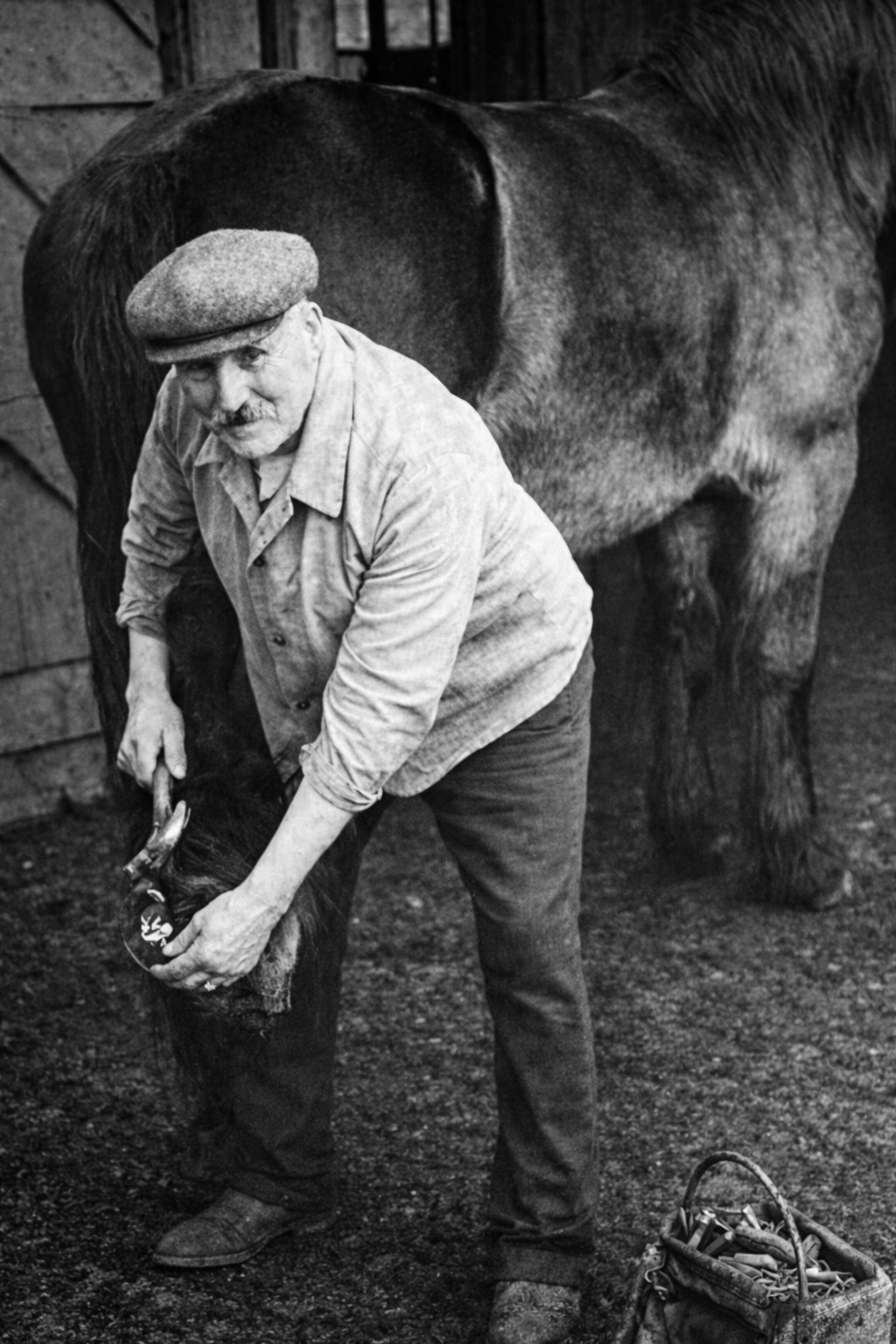
A puff of blue smoke from his forge chimney each weekday around 9am tells the people of Rode Heath that Arthur Edward Bateman is open for business, just as he has been for the past 55 years we reported in 1951.
Rode Heath’s oldest male resident, and one of the few genuine village smiths left in Cheshire, Mr Bateman — now 82 — will still fashion an implement or a spare part with a skill many would envy.
True, the boatmen from the canal, the hay and straw merchants and the light carriage horses from the halls no longer require his services, and the cherry-tipped iron bar on the anvil is now more likely to become part of a set of tractor harrows than a horseshoe. Yet his hammer is ready for any call, and the shaft that drives his bellows is still polished from constant use.
Mr Bateman is the eldest son of the late Edward and Elizabeth Bateman of Brereton Road, Rode Heath, and was born on 7th July 1869. The date — mid-cricket season — is fitting, for it was as a cricketer that he became widely known. He first played for Rode Park CC at the age of 13, a year after leaving school.
He was apprenticed to a smith at Brownlow, working a 12-hour day from 6am to 6pm for three shillings a week. He walked to and from work, and when later he went as an improver to the smithy at Astbury (where the garage now stands) he still travelled the same way. He took over the Rode Heath smithy in 1896.
The Rode Park Club was then a considerable force in non-league cricket, and Mr Bateman quickly came to the fore as a fast under-hand bowler, a wicket-keeper (it was common to take the gloves off to have a bowl), and a big-hitting batsman.
He played many times against Congleton teams and still chuckles at the memory of one match at West Heath, on the ground near the school. He opened the innings by hitting the first ball through a school window, repeated the feat with the next, and broke tiles on the school roof with the third — prompting an anguished Congletonian to shout: “Get him out — he’ll knock the b—— school down!”
Journeys to away matches were made in a brake, a kind of horse-drawn bus. The team would set off soon after dinner, reach Middlewich or Holmes Chapel around 3pm, play an innings each, and start for home just before dusk.
From the comments of Mr Bateman and his contemporaries, the sobriety of their coachmen varied. On one occasion the driver crossed his reins without noticing until the brake was careering down a steep hill out of control. The situation was saved by another well-known local sportsman, George Crawley — once of Stoke City and Tottenham — who leapt onto the horses’ backs and brought them up. A drunken driver was not always a handicap, however; some brake horses seemed able to find their way home better without human aid, more than can be said for a motor coach.
Mr Bateman won the “Sentinel” prize for the best performance outside league cricket three times: twice for batting and once for bowling (seven wickets for three runs at Middlewich, six of them clean bowled).
His highest score was 105 not out at Rode Park, first century made on the ground. Others have followed, but his remains unique, for the Park then had no boundaries and every run had to be run.
He captained Rode Park CC for 21 consecutive years and played his last match at the age of 70, appearing in a veterans’ side captained by the late Rev JH Lewis, founder of the present Rode Park Club.
Mr Bateman has also had a remarkable association with church music. He joined All Saints’ choir at the age of eight. As a bass singer he took part in the first local performance, at Odd Rode, of Stainer’s “Crucifixion”, and hopes to sing the work again this year at Lawton Church. He has been a welcome guest with many choirs, but is usually to be found on Sunday evenings at the Chapel of the Good Shepherd, Rode Heath.
He was a founder member of the Rode Heath Institute, where his prowess at whist is a by-word.
His wife, Mary Jane Bakewell, formerly cook-housekeeper at Rode Hall, whom he married in 1900, died in 1945 after years of suffering bravely borne.
Her loss, followed soon after by the death of his youngest daughter, Caroline, was a heavy blow. His son Frank holds an important post with British Railways, and his eldest daughter, Hilda, is married and lives at Betley.
His step is slower now, his back a little more bent, and his hair has the silvery whiteness of a man who has toiled. But his eye is as keen as in the days when he smote the bowling hip and thigh, and he carries the unmistakable stamp of a “character” in an age that is forgetting the meaning of the word.