
 Agency by William Gibson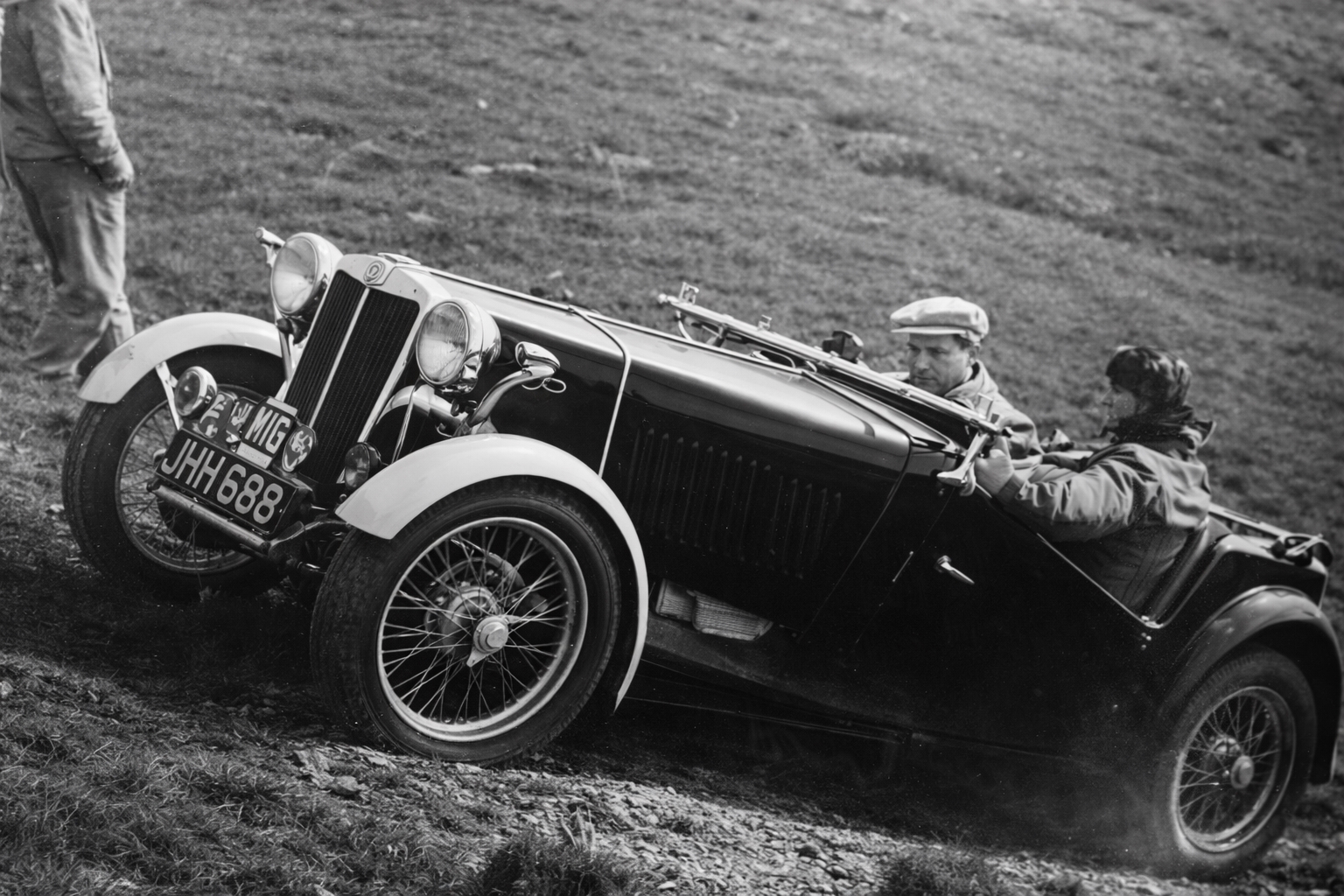
“No motorist in his right mind would use this road,” Ron Oakes told me as he swung his MG 11hp sports car off the main road on to a rough cart track leading over Congleton Edge, and accelerated up the steep gradient in the direction of Mow Cop, we wrote in 1951.
The track appeared to consist of boulders interspersed with cavernous depressions.
My head beat a tattoo on the canvas hood as the car bucked along the uneven surface like an untamed bronco.
“You can’t find anything quite like the proper trial courses near Congleton,” he said.
”This is like the roads leading up to some of the hill climbs. But it will give you the idea.”
It was a narrow track — just wide enough for a farm cart.
“It’s a very safe sport; it’s very rarely anyone gets hurt,” he said, as he picked up speed, swerved perilously out on to the grass verge and sped past a horse and cart that blocked the way.
Trial courses are found in the hills around Buxton and in North Wales.
From a standing start, the cars climb hills, preferably greasy with mud and with gradients of anything up to one in two.
Some courses include water hazards, the cars driving along river beds with three feet of water lapping over the wheels.
The trials are confined to winter. In summer, when the hillsides are dry, enthusiasts find them too easy to negotiate.
“It isn’t a question of speed,” Ron explained, careering along the Congleton Edge path at a pace reserved by normal motorists for wide, open stretches of the Great North Road.
“As often as not only one competitor completes all the obstacles successfully. If two finish, they have a manoeuvring test to decide the winner.”
We bumped down on to the main road at Newbold, and he demonstrated one of these manoeuvring tests.
From a standing start, we raced down the road towards an imaginary white line about 30 yards away. The speedometer flicked towards 40mph. When we reached the line, he jammed on the brakes, my head bumped forward into the windscreen, the car skidded bodily across the road, and we came to a halt with the wheels astride this line.
Without pausing, we then reversed sharply and halted with the front wheels behind this line, shot forward again to another line about 30 yards away, and came to another crashing halt, with the wheels astride this second line.
Other manoeuvring tests include: backing obliquely between tapes (representing a garage) with less than six inches to spare on either side; driving at speed round a centre pylon on a loose gravel track, and rocketing backwards along distances up to 100 yards.
Cars are specially adapted; many competitors build their own.
During the winter, Ron’s MG had cycle-type mudguards fitted, an aluminium bonnet reduced the weight, smaller wheels were fitted to take specially large tyres, and the batteries and all moveable parts were moved to the back to help the back wheels to grip on the greasy hillsides. The engine is highly tuned and runs on a specially mixed fuel.
Partnered by his wife or by Arthur Gibson, the British Legion steward, Ron (who works for his father at Oakes’ Corn Mill) has won ten trophies during his short three-year career as a trials driver. He has contested against — and, on occasion, beaten — stars of the calibre of Ian Appleyard (2,000-mile Continental trial winner) and Jeff Holt. Next season he hopes to have a specially built car, and is looking forward to even better results.
As we cantered home at a steady 50mph, I asked what was the idea of these trials. Why did they enter?
“It’s just for the sport of it,” he said.
Or, as one leading driver puts it: “The enthusiast can enjoy the thrills of strange adventure and satisfy that competitive instinct that is present in all of us.”
(Photo beefed up by AI)