
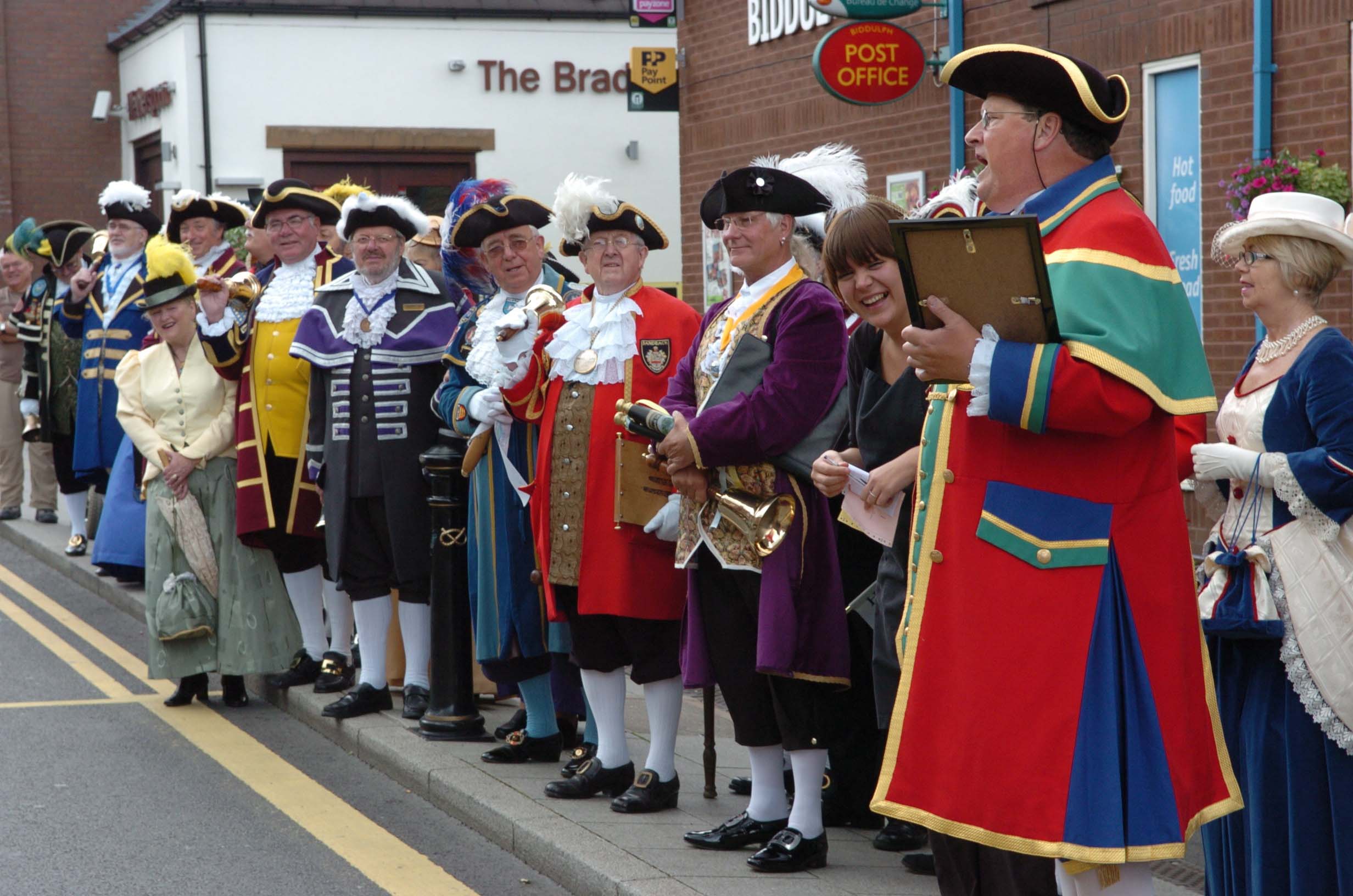
Biddulph’s town crier deserves a big shout out after the town was chosen to stage the 2026 British Town Criers Championships.
August’s event will be the fourth time the national competition has been staged in Biddulph – and John Robertson said he was “chuffed to bits” it had been chosen once again.
He told the “Chronicle”: “It’s not only a real crowd-puller on the day, but it’s the nationwide publicity Biddulph will get in the run-up to it. Criers come from across the country. When I sent out the invitations on Thursday, 11 had responded within 24 hours to say they would be competing.”
It was only thanks to Mr Robinson’s quick-thinking and enthusiasm for the competition to return to his home town, that organisers chose Biddulph.
This year’s competition had originally been pencilled in to be staged in Cromer, on the Norfolk coast, whose town crier Mark Northway was last year’s winner.
Mr Robinson explained: “It should have been in Cromer on 20th June but the council had only received four entries by last Sunday, and could not make a decision on whether or not to stage this year’s competition.
“I got a phone call from the chair of the Local Company of Town Criers offering the competition to me and I said ‘yes of course’.”
Mr Robinson, (73), who has been Biddulph’s town crier for 32 years, and who was crowned the national champion himself in 2005, added: “It will be the fourth time the national competition has been held in Biddulph and to be staging it again will be just fabulous.
“Then there’s all the national publicity Biddulph will get. Even if 15 to 20 town criers take part in the competition, invitations will have gone out to more than 100 across the UK.
“Eleven responded to say they would be taking part within 24 hours of me sending out the invites.”
While Mr Robinson will organise the event, he will be supported by Biddulph Town Council, which he thanked for its support, as well as that of the wider Biddulph community.
“The town council backs me throughout the year and this is my way of giving something back – and to the town as a whole, because the support I get is just unbelievable,” said Mr Robinson.
He has no plans to hang up his tricorn hat or muffle his bell for a long time.
“I absolutely love being Biddulph town crier – my wife Susan always jokes that I’ve got the biggest mouth in town!” he said.
“I just love the friendliness of its people, going out meeting and talking to them. I give talks and do ‘hatch, match and dispatch’ too.”
Eliza Mowe, of Barnoldswick, Lancashire, of the Loyal Company of Town Criers, said: “John Robinson is a wonderful crier and member of the LCTC.
“He has saved the British Championship this year, as our original host was unable to proceed. John said that he knew that Biddulph would support him in holding a British Championship and it has! “Biddulph and its crier are the heroes! Biddulph has always held amazing competitions and we are delighted it has taken up the mantle so late in the year to hold our flagship competition, and the LCTC membership thanks him and Biddulph for stepping in and saving it.” The national town crier championships will be held in Biddulph during the weekend of 21st-23rd August.
Origins
According to the Loyal Company of Town Criers, town criers and bellmen were the original “newsmen”, with their origins in the early Greek empire as Spartan runners. From the year 776 BC onwards the Olympic Games were opened by a contest for heralds and trumpeters. The ritual inauguration to choose which herald was to proclaim the judge’s verdict was the forerunner of the town crier competitions held today.
Stentor, a Greek warrior in the Trojan War, was said to have had a voice as powerful as 50 other men, hence the word “stentorian” to describe men with a loud voice – a typical town crier.
Town criers in Britain are thought to have come to the fore in 1066 when news of William of Normandy’s invasion was broadcast. They were known prior to that, and feature on the Bayeux Tapestry.
When Harold received news that William was about to attack and invade the South Coast, he had only a small army.
He decided to recruit a bigger army, but landowners turned deaf ears. So Harold issued criers with a proclamation, allowing them to enter freely any town or village to carry out the king’s command, and to speak freely without fear.
Although William was in the end victorious, he needed help from the English lords and used criers to implement his laws. He decreed all large towns and cities should have a town crier. He insisted that they go around to spread the new laws and warn of any danger.
Criers commence their cries with “Oyez, Oyez, Oyez” (roughly translated from Old French as “Hark” or “Listen to what I’m about to say”).
As the literacy of Britain’s population remained low well into the late 19th century, people came to rely on criers and heralds as a useful way of hearing about proclamations, edicts, laws, and news, as books and newspapers were generally only accessible to a small percentage of the English population.
Criers were not very popular in the time of King John, as they were given the role of tax man and had to collect the king’s taxes. Being an easy target, they were subject to being robbed by scoundrels, so King John passed a law: anyone who attacked a town crier or his partner while carrying out his duties as a town crier was and is guilty of treason and could be beheaded. This law has never been repealed.
As literacy spread, the town crier’s role was eventually superseded by newspapers and modern media, but there are lots of towns that still retain the position of town crier for civic ceremonies, leading parades and generally using their town crier to enhance the traditional character of their town and promote tourism.