

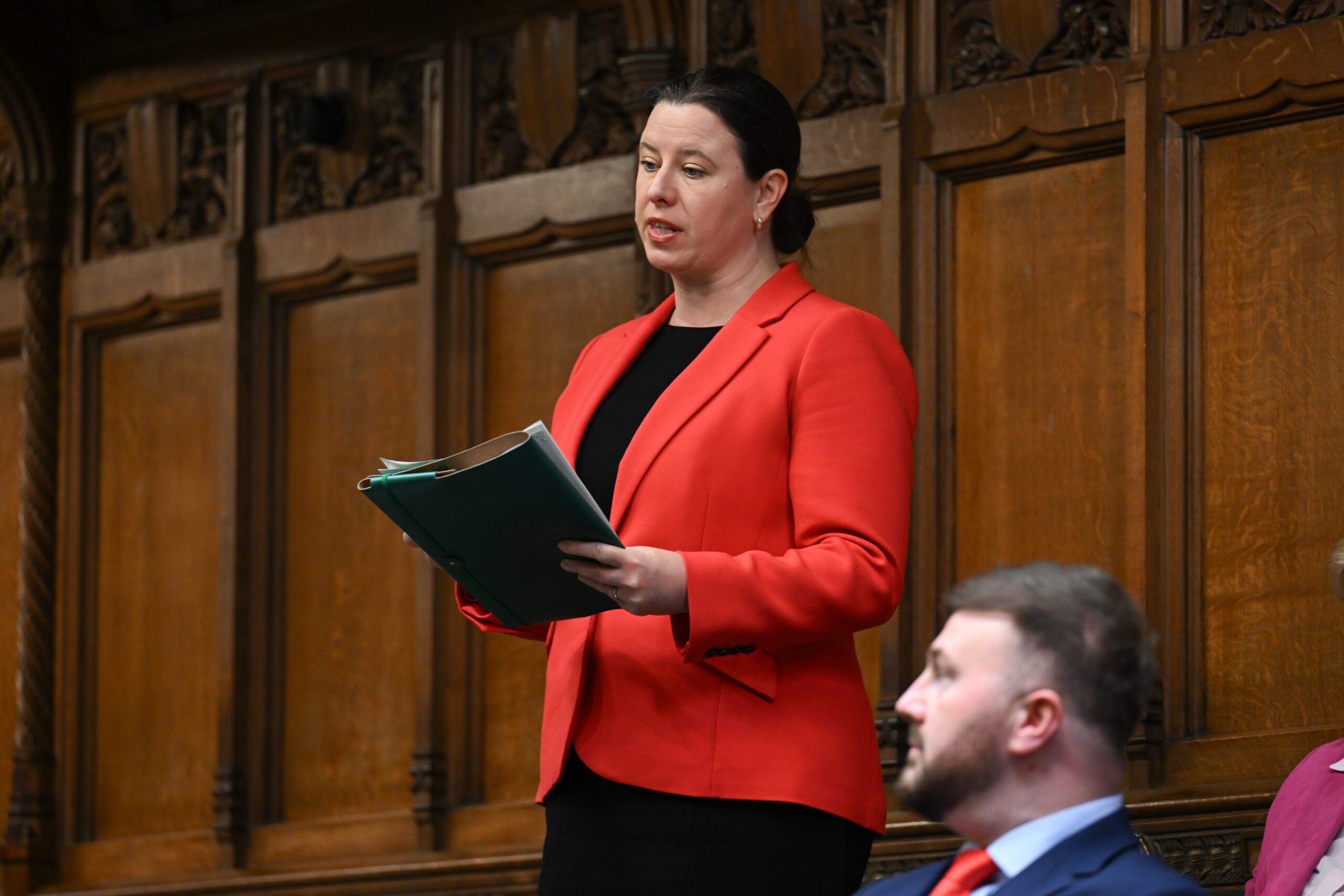
The Government needs to clamp down on immigration at the same time as allowing in essential workers, Congleton MP Sarah Russell has said.
Speaking in Parliament, she said she “entirely agreed” that the country needed control of its borders.
But she added: “Over the next 12 years there will be an 83% increase in the number of over-80s in my constituency. Health and care visa workers are currently providing critical services to many of my constituents, as well as supporting the NHS.”
She asked home secretary Shabana Mahmood to confirm how transitional arrangements would ensure that this care continues to be provided.
Ms Mahmood — who had earlier said that “the pace and scale of migration in this country has been destabilising” — responded that the health secretary and his department were “always reviewing and considering the arrangements”.
She said: “We need to ensure that we have a workforce capable of sustaining the national health service.
“We have an ageing population, which brings its own specific challenges. We are not talking about preventing people from working in our national health service; it is about the pathway to settlement.
“It is about extending the pathway from five to 10 years, and then thinking about the rules we need to bring that number down from 10 and closer to five years—or that might increase it instead.”
She added that she would be happy to talk to Mrs Russell.
Mrs Russell later told the “Chronicle”: “I know local people care passionately about appropriate control of immigration, which is why I called for the Government to do more about the lack of requirements for businesses to check the immigration status of those working in the gig economy. We need to reduce the pull factors that encourage people to make very dangerous Channel crossings.
“We must, however, be careful in our discussions on this topic. Foreign care workers came here lawfully in large numbers to do crucial work over the last few years, as have nurses from overseas. I would like to extend my thanks to them for the care they provide to individuals in their own homes, in care homes and hospitals throughout our area.”
She added: “Our local health and care services are reliant on workers from overseas. Local NHS senior leaders tell me racist attacks on their staff have increased in our area recently.
“The Government is working urgently on immigration control, but we must not allow concerns about this to result in abuse of anyone, especially of people who came to our country at our invitation and are doing vital work.”
Back in Parliament, Ms Mahmood said that 400,000 people had claimed asylum since 2021, “but that figure pales in comparison” with the net migration figure for the same period.
She said: “In that time, 2.6 million more people moved to Britain than left. To place that in perspective, around one in every 30 people in this country arrived in those four years.”
She blamed the rise on the Conservatives, saying: “This is the result of the extraordinary open-border experiment conducted by the last Conservative Government. In that period, now sometimes called the Boriswave, immigration controls were drastically lifted. This was most notable in the case of the health and care visa, for which minimum salary requirements were dropped.
“An attempt to fill between 6,000 and 40,000 jobs led to the arrival of 616,000 individuals between 2022 and 2024. Over half of those individuals were not even filling jobs in the sector—rather, they were dependants of those who were—and abuse was rife.”
Mrs Russell had pointed out that there was a loophole in UK employment law meaning that people who were self-employed were not subject to right-to-work checks, allowing many to work illegally in the gig economy with no potential risk to their “non-employer”.
Ms Mahmood said this loophole was being closed through the Border Security, Asylum and Immigration Bill.
Net migration to the UK fell by two-thirds in the year ending June 2025 compared with the previous 12 months, provisional figures indicate.
The difference between the number of people arriving in the country and those leaving was 204,000, down from 649,000, with the fall mainly driven by fewer arrivals for work and study reasons, the Office for National Statistics said.
(Photo: House of Commons / Flickr).