
 Agency by William Gibson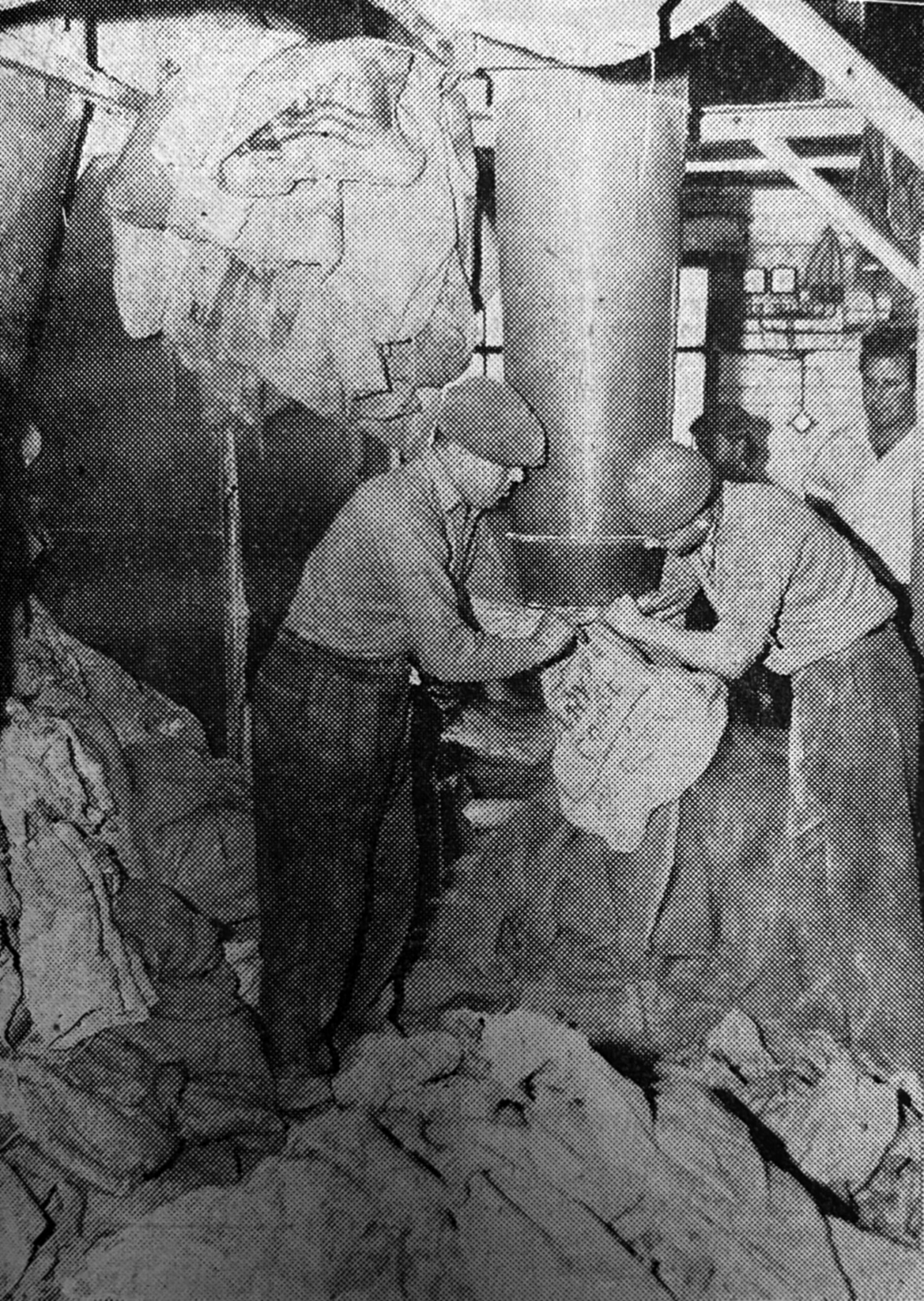
… we asked in 1958 on a visit to a Buglawton business.
To the fanner who has used the contents to feed his livestock — nothing. But to HT Bott, at Beaconsfield Mill, Buglawton, no sack is completely empty. With an average of 70,000 a day coming in for cleaning and repairing, they are able to extract enough meal dust from them to sell in bulk to a firm in the London area, though no-one is quite sure what use they make of it.
Nothing is wasted at Beaconsfield Mill, which pioneered the sack and lag trade in Congleton seven years ago. If a sack is beyond repair, it is sold to linoleum manufacturers or upholstery firms; if it can be re-used, it is sold back to the millers.
Five vans are used to collect sacks from farmers, bakers and greengrocers and sugar bags from grocers over an area stretching from South Staffordshire to South Lancashire and from the West Riding to North Wales. Others are bought from private collectors.
By the time the fanner has been paid, the margin of profit on each sack is extremely small, but the large quantities dealt with yield enough to pay the pages of 29 workers.
The compact, brick factory on the industrial site at Buglawton operates, with two shifts, for 22 hours a day.
Two large vacuum cleaners turn each sack inside out and suck out its remaining contents into a vertical bag some 10 or 11 feet tall.
Four women at sewing machines repair holes with jute, cotton or flax and then the sacks are sorted and graded for dispatch.
The firm has its manufacturing side, too, but the only things it makes at present are small twill bags for nuts, bolts and nails.
Seated in his somewhat spartan office (“We don’t go in for luxuries so much”) Mr HT Bott told a “Chronicle” reporter how he started with only one lad in 1951.
Since then, he has built up his trade at the expense of existing firms throughout the area and made Congleton a well-known centre for used sacks.
How has this been achieved?
“I’ve offered farmers fair dealings and a good price,” was his answer.
Collecting sacks required a lot of goodwill, said Mr. Bott.
At many farms it was a matter of “whether your face fits”, so much depended upon the collector’s personality and his firm’s reputation.
He was not the only sack and bag merchant in Congleton, he said, and more recently, similar businesses had started on a small scale. Throughout Britain, nearly 60,000 people were employed in the trade.
Of course, Mr Bott is not satisfied with the size of the business. He has plans approved with the council for extending on either side and increasing the output by 50%.