

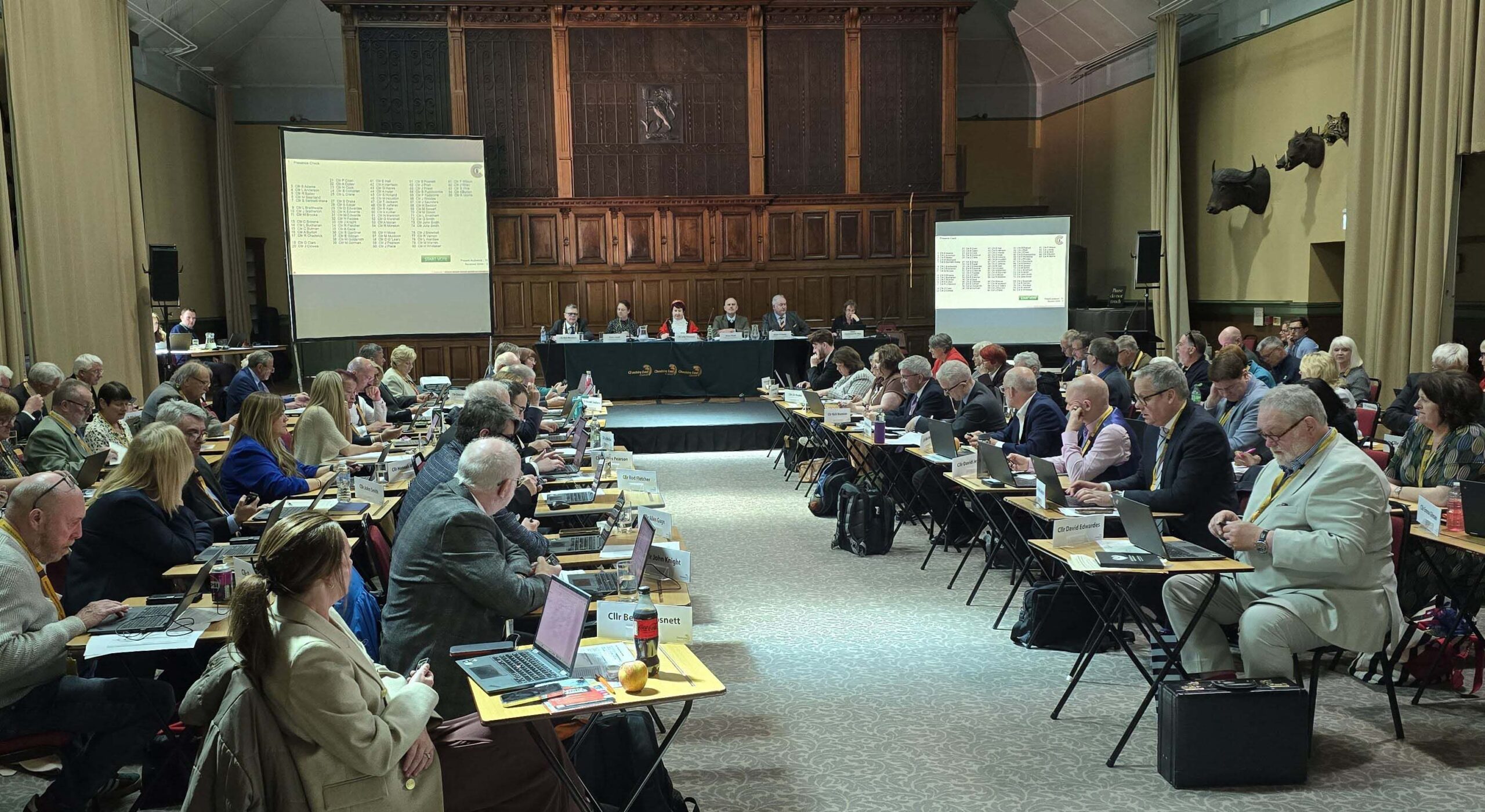
Labour councillor Nick Mannion has been re-elected as leader of Cheshire East Council – and said he welcomed the return to the Cabinet system of governance.
Coun Mannion was speaking on Wednesday after narrowly holding off a challenge from Conservative councillor Stewart Gardiner for the leadership.
Thirty-eight councillors voted for Coun Mannion, 34 for Coun Gardiner and three abstained (ITALICS writes local democracy reporter Belinda Ryan).
Coun Mannion told the meeting at Tatton Park that the return to the cabinet system would make decision-making at Cheshire East “better, faster and more decisive”.
The council, which is Labour/Independent controlled, operated a Cabinet system, mainly under the Conservatives, when it was originally formed in 2009. This changed to a committee system in May 2021.
The decision to revert to a leader and Cabinet-style of governance came on the back of the Government announcing plans for new legislation to abolish the committee system, which it said could be “unclear, duplicative, and wasteful, leading to slower, less efficient decision-making”.
Cheshire East’s slow decision-making process was also criticised in the 2024 Local Government Association peer challenge report.
Coun Mannion told the meeting that the council’s financial position had stabilised over the past 12 months.
“Our revenue position’s improved to a place where we’re now expecting to start building back our general reserves as planned when we set the budget in 2025/26,” he said.
The council leader said the finance team was finalising the year-end position and will be reporting to Cabinet at the beginning of July.
He added: “It is looking like there have been some additional net favourable changes that mean the position will improve at the bottom line, and this will mean the need to take less exceptional financial support than our budget earlier this year forecast.
“This is good news for the council but, as I am informed by our executive director for resources in his own quietly assertive way, there are still many improvements needed around forecasting accuracy, as some of the improvements could have been foreseen.”
Coun Mannion said looking ahead the council must “continue to think differently about how we deliver, what we deliver, and change how we engage with our residents” to meet their future needs – especially the needs of the most vulnerable.
The cabinet and committee systems are the two primary models of governance used in local government and Parliamentary systems.
The cabinet model consolidates decision-making into a small, executive group, prioritising speed and accountability. Decisions are made much faster, often at regular, frequent meetings or by individual portfolio holders and the public can see who did what.
However, opposition parties frequently feel excluded from decision-making, necessitating the use of “overview and scrutiny” committees to hold the cabinet to account.
The committee system disperses decision-making among politically balanced groups of elected members, stressing inclusivity, transparency and wider debate.
This means all political groups and independent members are directly involved in the actual decision-making process, rather than just debating it after the fact.
Because decisions are subject to more debate and cross-party negotiation, the process can be slow, cumbersome, and prone to duplication of work.
In the UK, many councils transitioned from committee systems to the cabinet model under the Local Government Act 2000 to increase efficiency.
The Government has made the leader and cabinet model mandatory for all councils, scrapping the option for the committee system entirely, except in the 13 areas that already have directly elected mayors.
The Cabinet appointments were: council leader, Nick Mannion; deputy leader, Michael Gorman; highways and transport, Mark Goldsmith; environment, sustainability and waste management, David Jefferay; planning, housing and regeneration, Mick Warren; communities and engagement, Rob Vernon; finance, legal and enforcement, Dawn Clark; adult social care, Jill Rhodes; children’s services, Laura Crane, and education and SEND, Emma Gilman (Ind).